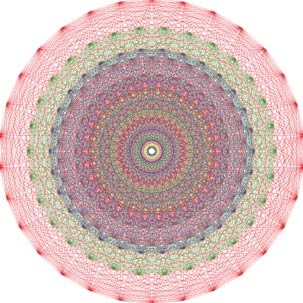
A major mathematical feat by a team of 18 scientists, including two from MIT, has received a commendation from Congress, one week after the work made international headlines after being unveiled at MIT.
On Tuesday, March 27, Rep. Jerry McNerney (D-Calif.) read a statement to Congress about the work, which involved mapping one of the largest and most complicated structures in mathematics. If written out on paper, the calculation describing this structure, known as E8, would cover an area the size of Manhattan.
The work is important because it could lead to new discoveries in mathematics, physics and other fields. In addition, the innovative large-scale computing that was key to the work likely spells the future for how longstanding math problems will be solved in the 21st century.
On March 19 MIT's David Vogan, a professor in the Department of Mathematics and member of the research team, unveiled the team's results in a talk at MIT to a standing-room-only crowd. Vogan's MIT colleague on the E8 team is Dan Ciubotaru, the CLE Moore Instructor in the Department of Mathematics.
In his statement, which will be included in the Congressional Record, McNerney concluded: "The participants are to be commended for their work that has expanded the limits of human knowledge and brings hitherto unknown beauty and power to grace our human condition."
McNerney, who has a Ph.D. in mathematics, represents the district that is home to the American Institute of Mathematics (AIM). The E8 project was funded by the National Science Foundation through AIM.
A version of this article appeared in MIT Tech Talk on April 4, 2007 (download PDF).