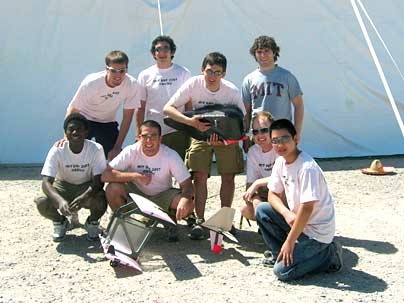
A team of MIT students in aeronautics and astronautics has taken first place in the American Institute for Aeronautics and Astronautics' annual Design/Build/Fly competition, ending Oklahoma State's three-year reign.
The competition, held the weekend of April 20 in Tucson, Ariz., is the culmination of a yearlong development cycle in which student teams design, build and test fly radio-controlled aircraft to comply with rules released at the beginning of the school year.
Robert Liebeck, professor of the practice in aeronautics and astronautics, said he was "struck by the elegance" of MIT's concept.
"Given the design specification and the scoring criteria, the MIT team created an airplane concept that was indeed distinct from all the others--distinct in its simplicity, distinct in its functionality and distinct in that it was able to win all but one of the scoring flights. This is an outstanding accomplishment," he said.
In Liebeck's words, the contest rules for 2007 required the aircraft to carry "two different payloads and perform two ground missions, which involved readying the aircraft for flight as quickly as possible and swapping the two payloads. Scoring favored small, light aircraft, and MIT capitalized with a two-foot span biplane weighing less than two pounds. The next lightest aircraft weighed five pounds."
The MIT team's victory "raised the bar," Liebeck noted. "As an airplane designer guy, I feel a bit humble."
The team of eight aero-astro students are George Kiwada G, Nii Armar G, Carl Engel '07, Adam Woodworth '07, Brandon Suarez '09, Ryan Castonia '09, David Sanchez '09 and Fuzhou Hu '09). Professor David Miller of aeronautics and astronautics advised the team with the help of Professor Mark Drela, lecturer Col. Pete Young and research specialist Paul Bauer.
A version of this article appeared in MIT Tech Talk on May 23, 2007 (download PDF).