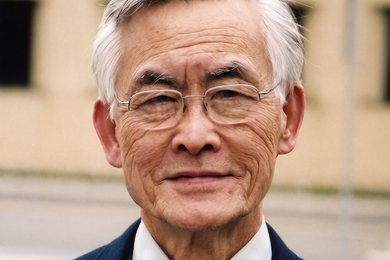
KENNETH L. THOMPSON
Kenneth L. Thompson, a retired product manager in the Department of Physical Plant, died Oct. 27 at the age of 82.
Thompson worked at MIT for 42 years redesigning and supervising the reconstruction of classrooms and laboratories, said his wife, Ruth Thompson. He was also a longtime member of the Committee for Review of Space Planning. He retired from MIT in 1992.
Born and raised in Marblehead, he joined the Air Force in 1943 and served as a pilot during World War II and the Korean War. He graduated from St. Anselm College and the Wentworth Institute of Technology, majoring in architectural construction.
He is survived by his wife, Ruth Thompson; two daughters, Linda Olmstead of Westford and Kristin Doucet of Bedford; and four grandchildren.
PAULINE M. MARCHANT
Pauline M. Marchant, a research nurse at the MIT General Clinical Research Center for 26 years, died Jan. 4. She was 64.
Marchant, who had planned to retire this February, was a protocol nurse for many clinical studies and cared for patients with a wide variety of ailments.
Marchant is survived by a son, Peter Marchant of Stoneham; a daughter, Paula Stavre of Stoneham; a brother, James Byrne of Revere; a sister, Barbara Bernis of Somerville; and four grandchildren.
Donations may be made to the Middlesex East VNA/Sawtelle Hospice House, 320 Haverhill St., Reading, MA 01867.
A version of this article appeared in MIT Tech Talk on January 25, 2006 (download PDF).