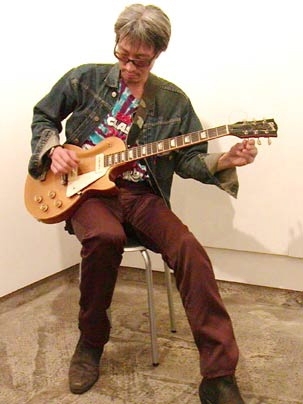
Japanese guitarist and composer Tetuzi Akiyama, a leading figure in Tokyo's improvisational music world, will perform at MIT on July 11.
Akiyama, 42, has recorded more than 50 compositions. His recent solo CDs include "Terrifying Street Trees," "Route 13 to the Gates of Hell" and "Don't Forget to Boogie," a collection of blues works that pay informal tribute to Canned Heat, Led Zeppelin and John Lee Hooker.
Akiyama will perform alone and with two Boston musicians, trumpeter Greg Kelley and cellist Vic Rawlings, at the Center for Advanced Visual Studies (CAVS) at 8 p.m. Admission is $7.
True to the improv spirit, Akiyama advised those who attend his MIT concert to "just feel free to have any impression -- get laid back and listen to both the quiet acoustic style and the loud electric boogie guitar excursions." In his music, Akiyama said he seeks "something that is obvious but being missed in daily life. Listen carefully! "
CAVS' Meg Rotzel collaborated with Dan Hirsch, one of four Boston music curators known collectively as Non-Event, to bring Akiyama to MIT.
CAVS "wants to foster the activities of experimentation while opening up its processes to the MIT community and the public. Through working with Non-Event, we are able to promote the medium of sound and invite new audiences to our space," Rotzel said.
According to Hirsch, it is a "coup" for CAVS and Non-Event to have the prolific, innovative Akiyama perform in the intimate CAVS setting - Room 390 in Building N52 at 265 Massachusetts Ave.
"Tetuzi is part of a community of musicians in Japan whose sound is known as 'onyko,' which roughly translates to 'reverberating sound.' A response to the noise music of the Japanese underground, 'onyko' is generally comprised of small gestures, silence, acoustics, electronics and improvisation," Hirsch said.
"Onyko" performances have been compared to works by the U.S. composer John Cage. Japanese noise rock is epitomized by the "King of Noise," Merzbow (who was born Masami Akita), and the late 1980s band Boredoms. In its early years - the mid to late 1990s -- 'onyko' was an "austere sound," Hirsch said. "Tetuzi moved beyond that, assimilating blues and folk influences in his work."
Akiyama will play two sets at CAVS -- a solo electric set and an improvisational acoustic set with Kelley and Rawlings.
Kelley is lead trumpeter for Nmperign, Heathen Shame and Cold Bleak Heat. He has performed previously with Rawlings, a cellist and instrument builder who has used exposed circuit boards and salvaged speaker cones to form new sonic objects.
Non-Event is supported in part through a grant from the LEF Foundation. Additionally, Akiyama's performance is presented with support from the Society for the Activation of Social Space through Art and Sound and the Japan Foundation through the Performing Arts JAPAN program.