Skip to content ↓

Stroock meets Stroock fellow

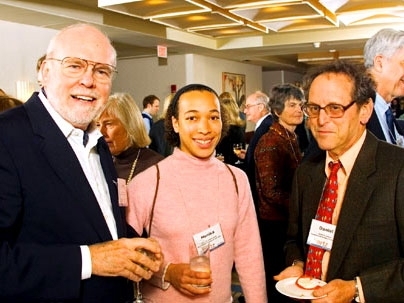
MIT Professor Daniel W. Stroock, right, meets Stroock-Hertz Fellowship recipient Monika Schleier-Smith, center, an MIT graduate student working in quantum optics, and Hertz Fellow John Holzrichter, president of the Fannie and John Hertz Foundation, in Cambridge on Friday, Oct. 21.
Caption:
MIT Professor Daniel W. Stroock, right, meets Stroock-Hertz Fellowship recipient Monika Schleier-Smith, center, an MIT graduate student working in quantum optics, and Hertz Fellow John Holzrichter, president of the Fannie and John Hertz Foundation, in Cambridge on Friday, Oct. 21.
Credits:
Photo / Chris Milliman, courtesy of Hertz Foundation

The MIT community is very familiar with endowed fellowships named for their donors. But when Ray Sidney '95, an early software engineer at Google, decided to make a gift, he established the Stroock-Hertz Fellowship in honor of his MIT math professor, Daniel W. Stroock, the Simons Professor in Mathematics.

Stroock met the recipient of the Stroock-Hertz Fellowship, MIT physics graduate student Monika Schleier-Smith, at a dinner given by the Hertz Foundation for Hertz Fellows in the Boston area on Friday, Oct. 21.

Institute Professor John M. Deutch and Hertz Fellow Alice Gast, who is MIT's vice president for research and associate provost, were featured speakers at the dinner, which followed a meeting of the foundation's board of directors.

Also attending were Brett Bethke and Stephen Samouhos, both Hertz Fellows studying for their doctorates at MIT.

Hertz Fellows receive up to $240,000 each for up to five years of study toward their doctorates.

A version of this article appeared in MIT Tech Talk on October 26, 2005 (download PDF).
Related Topics

More MIT News

Globular blue and white orbs "examining" single-stranded RNA products and marking them with green checks or red x's

Why are some bacterial genes high in purines?

In certain species of bacteria, the answer lies in shielding RNA transcripts from a quality-control factor called Rho. Understanding the requirements for expressible sequences is critical for expression engineering of therapeutic agents.

Read full story

Rich Nielsen, Volha Charnysh, Kevin Dorst, and Emily Richmond Pollock seated at a table, talking

Building a scholarly community

The SHASS Faculty Fellows Program, administered by the MIT Human Insight Collaborative, is fostering new research projects and creating space for supportive and interdisciplinary discussion.

Read full story