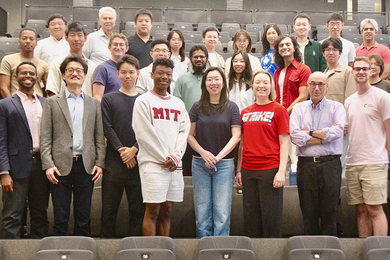
The School of Humanities, Arts and Social Sciences has named 30 sophomores and juniors Burchard Scholars for 2005.
The awards, named after the school's first dean, John Ely Burchard, are given to students who demonstrate unusual abilities and academic excellence in the areas embraced by the school. According to Dean Philip S. Khoury, co-founder of the Burchard Program and chair of the selection committee, the students selected in the 19th year of competition for the awards are a "remarkable group of gifted young scholars from diverse backgrounds."
Burchard Scholars will be invited to a series of dinners with a rotating group of faculty beginning in February. At each dinner, an MIT faculty member or visiting scholar will present work in progress, followed by a discussion to provide students with the opportunity to engage in the kind of intellectual exchange that characterizes scholarship in the humanities, arts and social sciences. The emphasis throughout the program will be interdisciplinary. Professor Stephen Meyer of political science directs the Burchard Scholars Program.
The new Burchard Scholars are juniors Leila Agha, Anna Bershteyn, Molly Bright, Lydia Chilton, Elizabeth Farrelly, Emily Fenn, David Glasser, Jonathan Harris, Neera Jain, Brian Keegan, Ingrid Lawhorn, Wen Li, Jolinta Lin, Heather Phipps, Adjoa Poku, Eleanor Pritchard, Jonathan Reinharth, Jessica Rhee, Philip Richerme, Frances Roberts, Christopher Suarez, Jeanette Tse and Dan Wheeler.
Sophomores selected as Burchard Scholars are Louis Fouch̩, Charles Jernigan, Cynthia Lin, Mitra Lohrasbpour, Christine McEvilly, Ruth Miller and Ashley Tran.
A version of this article appeared in MIT Tech Talk on February 2, 2005 (download PDF).