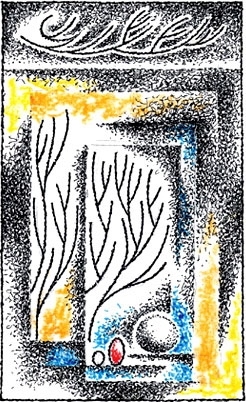
A new exhibit at the MIT Museum highlights the work of Richard Filipowski, a sculptor of international reputation who taught visual design here for 36 years.
Filipowski, who joined MIT's faculty in 1953, was the first to introduce the teaching methods of the German design philosophy Bauhaus to MIT. He also developed a pioneering course on design theory, leaving a lasting influence on the curriculum of MIT's School of Architecture and Planning.
"Finding Form: The Work of Richard Filipowski," currently on view near the entrance of the MIT Museum, focuses on his sculpture and graphic art, demonstrating his influential design curriculum and revealing his pivotal manipulations of form and color.
Filipowski has described his work of "finding form" as a "sustained search for spatial-structural-emotional concepts." Today Filipowski maintains a daily commitment to "finding form," usually preferring to work in colored ink on paper. The exhibition includes a selection from the MIT Museum's Filipowski Collection, including examples of some of his earliest work in sculpture and on paper, and recent work from the artist's collection.
Now in his 80s, Filipowski is still looking ahead. "I don't know what happens next, where the language I have developed ��� will lead," he said in an interview with Jon Markowitz Bijur, coordinator of Educational Services at the MIT Museum. "It leads to totally new surprises. The question in my mind is whether I recognize them as they come along. That is ��� the mystery of creativity," he said.
"Finding Form: The Art of Richard Filipowski" runs through Friday, Feb. 17. For more information, see web.mit.edu/museum.
A version of this article appeared in MIT Tech Talk on December 14, 2005 (download PDF).