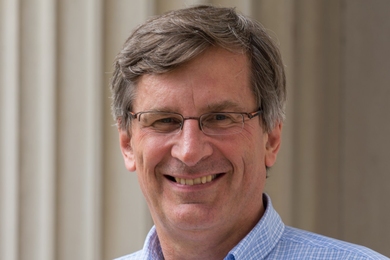
More than five dozen names have emerged as potential candidates as the next president of MIT, but there may be additional names considered even as the field is winnowed, said Jerome I. Friedman, chair of the Faculty Advisory Committee to the Corporation on the Presidential Search (FAC).
The goal of his committee and that of the Corporation Committee on the Presidency (CCOP) "is to have a new president in the fall," Friedman said. "But we'd rather be correct [selecting the best new president] than to be on time."
Friedman made his remarks at an Administrative Council luncheon on Feb. 17, when he explained the search process and answered questions.
In this early stage of the search, leaders of the principal MIT presidential search committees are continuing to solicit opinions and answer questions from MIT community members about the process. The search committees are meeting with several groups, "and we have collected some extremely valuable comments in this extremely challenging operation," Friedman said.
In addition to the Administrative Council, the search committee chair will address the Leader to Leader Program alumni, the Working Group on Support Staff Issues, the Lincoln Laboratory Steering Committee and all members of the Academic Council (including senior officers, deans and vice presidents).
Members of the Student Advisory Group to the Corporation will visit an upcoming joint meeting of the CCOP and FAC to offer their report. Finally, members of the CCOP and FAC will meet with the Corporation Joint Advisory Committee on Institute-Wide Affairs (a standing committee that includes Corporation, student and faculty members) to get input.
President Charles M. Vest announced on Dec. 5 his intention to step down from the post he has held more than 13 years. He said he would remain in office until a new president is named.
A version of this article appeared in MIT Tech Talk on February 25, 2004.