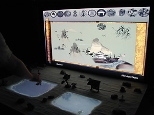
Combine Buddhist principles, Asian philosophy and traditional Japaneses culture with images from Japanese ink painting and haiku. Now run it all through a computer. That's what Naoko Tosa, a research fellow at the Center for Advanced Visual Studies, and her collaborator Seigo Matsuoka, director of Editorial Engineering Labs in Tokyo, did to create "The ZENetic Computer," an interactive installation that opens at the MIT Museum on Friday, Oct. 24 with a reception from 6-8 p.m.
Visitors are encouraged to create their own pictures and stories on a large rice-paper screen while learning about Zen, Japanese art and themselves. Tosa will be on hand to guide visitors toward an altered state of mind augmented by improvisational jazz trumpeter Toshinori Kondo.
"We're trying to help the consciousness of our 'daily self' meet that of our 'hidden self' through creative resources deep within us that may have been forgotten but still resonate with vital meaning," said Tosa. She noted that while it's difficult to meld the conscious and unconscious selves through traditional logical means, using scientific computing images from traditional Japanese media can help bridge the gap.
The exhibition will be on view through Nov. 13.
A version of this article appeared in MIT Tech Talk on October 22, 2003.