
Skip to content ↓

Letting the sparks fly

Credits:
Photo / Donna Coveney
Credits:
Photo / Donna Coveney
Credits:
Photo / FRANCIS BITTER MAGNET LAB

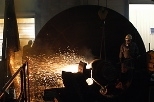
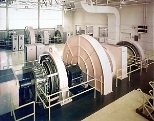
Two 84-ton, 10-megawatt motor generators used since 1963 to power the Bitter and hybrid magnets at the Francis Bitter Magnet Laboratory are being dismantled to make room for a high-field superconducting NMR magnet and spectrometer. A Victor R1500 oxygen/propane torch (top photos) is used to cut into the 20-inch steel flywheels that stored the energy used to drive the generators. The generators (bottom photo) were used in numerous experiments, including the discovery of the fractional quantum Hall effect, for which the Nobel Prize in physics was awarded in 1998. The spectrometer, part of the MIT/Harvard Center for Magnetic Resonance, will be used for structural studies of proteins, nucleic acids and other biological systems.

A version of this article appeared in MIT Tech Talk on October 22, 2003.
Related Topics

More MIT News

Globular blue and white orbs "examining" single-stranded RNA products and marking them with green checks or red x's

Why are some bacterial genes high in purines?

In certain species of bacteria, the answer lies in shielding RNA transcripts from a quality-control factor called Rho. Understanding the requirements for expressible sequences is critical for expression engineering of therapeutic agents.

Read full story

Rich Nielsen, Volha Charnysh, Kevin Dorst, and Emily Richmond Pollock seated at a table, talking

Building a scholarly community

The SHASS Faculty Fellows Program, administered by the MIT Human Insight Collaborative, is fostering new research projects and creating space for supportive and interdisciplinary discussion.

Read full story