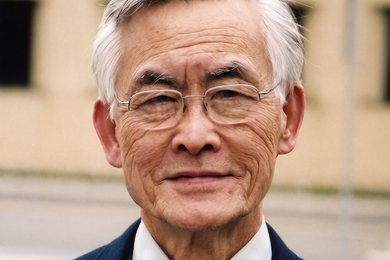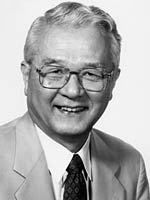
Satoru Masamune, an MIT professor of organic chemistry for 22 years, died of complications from cardiac arrest Sunday at Newton-Wellesley Hospital. He was 75 years old.
Masamune, a native of Fukuoka, Japan, joined the MIT faculty in 1978. He made significant contributions to the field of organic chemistry in two broad areas, the synthesis of natural products and the chemistry of small ring systems.
After receiving the B.S. in chemistry from Tohoku University in Sendai, Japan, in 1952, he attended the University of California at Berkeley as a Fulbright Fellow and earned the Ph.D. in organic chemistry in 1957. Masamune was on the faculty of the University of Alberta in Edmonton, Canada, from 1964-78.
The American Chemical Society cited him for creative work in 1978 and presented the A.C. Cope Scholar Award to him in 1987. The award honors Arthur C. Cope, who headed the MIT Department of Chemistry from 1945-65. Masamune was named the Arthur C. Cope Professor of Organic Chemistry in 1991.
Masamune, who retired in 2000, was a fellow of the Royal Society of Canada and of the American Academy of Arts and Sciences. He was the Centenary Scholar of the Chemical Society of London in 1980 and received the prestigious Fujihara award in Japan in 1997.
A longtime resident of Newton, Mass., Masamune is survived by his wife, Takako (Nozoe) of Newton; a daughter, Hiroko of Noank, Conn.; a son, Tohoru of Los Angeles; a sister, Michiko Hiyama of Hirosaki, Japan; and four brothers, Tadashi of Sapporo, Japan; Osamu of Akita, Japan; and Shinobu and Tsutomu, both of Tokyo.
A memorial service was held at the MIT Chapel on Nov. 14. Donations in Masamune's memory may be made to the Department of Chemistry, c/o Professor Stephen Lippard, Room 18-390, 77 Massachusetts Ave., Cambridge, MA 02139.