In a step that might help explain the mystery of how high-temperature electrical superconductors work, three research groups around the globe--including one at MIT--have observed molecules form a collective identity at ultracold temperatures.
This collective behavior in which the molecules act as one entity is called a Bose-Einstein condensate (BEC).
Wolfgang Ketterle, professor of physics at MIT, shared the 2001 Nobel Prize in physics for causing atoms to march in lockstep as a single entity, thus discovering a new form of matter. Bose-Einstein condensation has revolutionized atomic physics, spawning thousands of research papers since its discovery in 1995. These latest reports mark the first time researchers have persuaded molecules to act like the atoms in a BEC.
The three groups at the University of Innsbruck in Austria, the National Institute of Standards and Technology in Boulder, Colo., and MIT submitted their papers to Science, Nature and Physical Letters Review, respectively. All three journals rushed the papers into print with a highly unusual four-week turnaround time.
The three groups bypassed the unsolved problem of cooling molecules to ultralow temperatures by first cooling atoms and then having the atoms form molecules in a chemical reaction. (The Innsbruck and MIT groups used lithium; the Boulder group used potassium.) At a special magnetic field, the reaction releases no or very little heat, and a molecular gas was formed at temperatures less than a millionth of a degree above absolute zero, the temperature at which atoms come to an almost complete stop.
This coincidence--where atoms and molecules have the same energy--is called a Feshbach resonance. It was first observed by the MIT group in 1998.
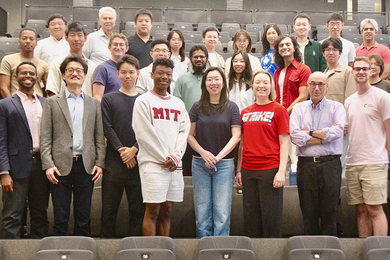
The work of the MIT group, which includes graduate students Martin A. Zwierlein, Claudiu A. Stan, Christian H. Schunck, Sebastian M.F. Raupach, Subhadeep Gupta and Zonan Hadzibabic, featured the largest molecular condensates of up to 900,000 molecules, a direct method of observation and a long lifetime of the molecular gas.
Creating BECs from molecules could shed light on high-temperature superconductors. Discovered in 1987, these ceramic materials conduct electricity with zero resistance and could one day be used in levitating trains, wires that effortlessly carry electricity and ultrafast computers.
Ketterle's group's work was supported by the National Science Foundation, the Office of Naval Research, the Army Research Office and NASA.