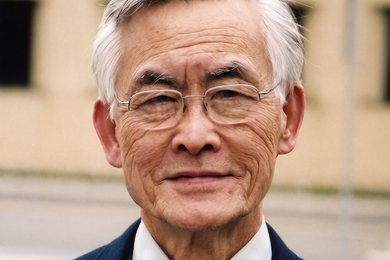
Cecil H. Green (S.B. and S.M. 1924), a worldwide philanthropist whose family name graces the tallest building on the MIT campus as well as a women's residence hall and nine endowed professorships, died on April 11 of complications from pneumonia at the age of 102.
He died at his residence in a hospital he endowed, the Scripps Green Hospital in La Jolla, Calif.
Green and his late wife, Ida, donated $31,752,759 over four decades to MIT, equal to more than $91 million in today's dollars. The New York Times obituary reported that their philanthropy totaled $200 million.
There are buildings named after the Greens at MIT, the University of British Columbia, Stanford, Scripps Health Center in La Jolla, the University of California at San Diego, the Colorado School of Mines, the University of Texas Southwestern Medical Center at Dallas, Baylor University, the National Research Council in Washington, D.C., and the Magellan Telescope in Chile. In England, Green's philanthropy was responsible for the establishment of Green College at Oxford University.
At MIT, the Greens provided major funding for the 295-foot-tall Cecil H. and Ida F. Green Center for Earth Sciences, designed by I.M. Pei, and the Ida Flansburgh Green Hall for graduate women. A major renovation in the Department of Physics will be named the Cecil H. and Ida F. Green Center for Physics.
The Greens endowed six full MIT professorships and three faculty career development chairs. Funds for one of those has been used to support the MacVicar Faculty Fellowship program.
Green was a member of the MIT Corporation since 1958.
He co-founded Texas Instruments, Inc. in 1951 and amassed a fortune by the time he retired in 1975. After that, he devoted his life to giving away the fortune.
"The idea is to get down to my last nickel before I die," he said in the 1990s.
Born in Manchester, England, on Aug. 6, 1900, Green moved to Canada as an infant and on to San Francisco in 1905, where his father was a cable car operator. Shortly after the 1906 earthquake, the family moved to Vancouver, B.C.
He attended the University of British Columbia before going to MIT. At MIT he received the S.B. and S.M. in electrical engineering, and is listed as a member of the Class of 1923. Green sold neon lighting, automobiles and insurance before he began his engineering career in 1924 at General Electric in Schenectady, N.Y., where he met Ida Mabelle Flansburgh. They were married two years later.
The Greens had no children and there are no survivors.
A memorial service was held April 17 in La Jolla. Burial was private.
A longer version of this story is on the web at /newsoffice/nr/2003/green.html.
A version of this article appeared in MIT Tech Talk on April 30, 2003.