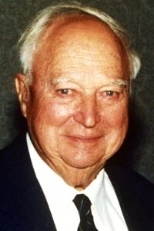

Ivan A. Getting (S.B. 1933), a division director at the MIT Radiation Laboratory during World War II and a key figure in developing the Navstar Global Positioning System (GPS), died at his home in Coronado, Calif., on Oct. 11.
Getting, 91, attended MIT as an Edison Scholar and majored in physics. He was born in New York City on Jan. 18, 1912 and grew up in Pittsburgh.
He was the founding president of the Aerospace Corp. in El Segundo, Calif., in 1960 and headed the firm for 17 years. The military research and development company created the worldwide GPS satellite technology, the most significant advance in navigation in the 20th century.
After graduating from MIT, Getting attended Oxford University as a Rhodes Scholar and earned a Ph.D. in astrophysics. He then spent five years conducting research on nuclear instrumentation and cosmic rays as a junior fellow at Harvard, developing the first high-speed flip-flop circuit.
Getting returned to MIT as the director of the Division of Fire Control and Army Radar at the Radiation Laboratory from 1940 to 1945. His group developed the first automatic microwave tracking gunfire control radar, the SCR-584, which was credited with destroying 95 percent of the V-1 bombs flown against England during World War II.
From 1945 to 1950, he was a professor of electrical engineering at MIT and headed a group that developed and built a 350-million electron volt synchrotron. During the Korean War, he served as assistant for development planning of the Air Force. He left MIT to join Raytheon Co. as vice president of research and engineering. While there, he was responsible for the development of the Sparrow III and Hawk missile systems.
In 1956, while a member of the Undersea Warfare Committee of the National Research Council, Getting was asked to serve as associate director of a special three-month study (Project Nobska) sponsored by the U.S. Navy and concerning submarine warfare weapons. Among the recommendations of the study group was a submarine-based, solid-propellant intermediate-range ballistic missile that formed the basis for what became the Polaris missile.
Getting and his Aerospace colleague, Bradford Parkinson, were awarded the prestigious Charles Stark Draper Prize by the National Academy of Engineering earlier this year for inventing the GPS. Getting was inducted into the San Diego Aerospace Museum's International Aerospace Hall of Fame last year.
Getting was a fellow of the American Physical Society and the Institute of Electrical and Electronic Engineering, and president of IEEE in 1978. He was an honorary fellow of the American Institute of Aeronautics and Astronautics, and a member of the American Academy of Arts and Sciences and the National Academy of Engineering. Getting served on numerous high-level government committees and received many awards, including the Navy Superior Public Service Award in 1999 "for his outstanding record of lifetime support to the Navy's science and technology program."
Getting is survived by his wife, Helen; a daughter, Nancy G. Secker of Green Bay, Wis.; and two sons, Ivan C. of Boulder, Col., and Peter A. of Iowa City.