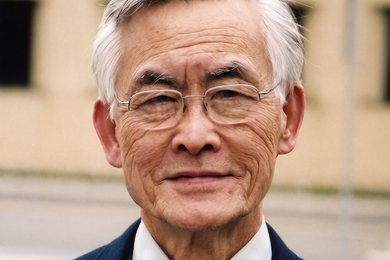
Jiro Adachi of Eagan, Minn., a former officer in the Industrial Lisiaon Program (ILP), died on Oct. 19 at the age of 80. During World War II, he served with the U.S. Army Military Intelligence Service and was a civilian engineer with the U.S. Army in Japan. He earned the Civil Engineer and S.M. degrees from MIT in 1953. After a 30-year career in structural mechanics with the U.S. Army Materials and Mechanics Research Center in Watertown, he joined the ILP in 1986 and worked there until his retirement in 1996.
Adachi is survived by his wife, Eldora (Clobes); two daughters, Janet Kei Adachi of Acton and Patricia Mari Adachi of Framingham; a son, Michael Sho Adachi of Redding, Calif.; and a brother, James Shogo Adachi of San Francisco. A memorial service was held following cremation on Oct. 23 in Fort Snelling State Park, Minn. His ashes were interred at Hillside Cemetery in Minneapolis, and at several sites in Massachusetts. Gifts in his memory may be made to the Mayo Foundation for Medical Education and Research--Cancer Research Programs, Mayo Clinic, 200 1st St. S.W., Rochester, MN 55902-9817; or to the MIT Civil and Environmental Engineering Development Fund. For information, e-mail giving@mit.edu or call (800) MIT-1865.
A version of this article appeared in MIT Tech Talk on November 5, 2003.