Skip to content ↓

Habitat for Humanity gains from 2.009 projects

Press Contact:

Denise Brehm
Phone: 617-253-8069
Department of Civil and Environmental Engineering

Media Download

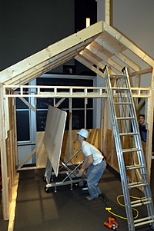
Dale Cotton, a junior in mechanical engineering, demonstrates the drywall/sheetrock lift and installation system designed and built by his team in 2.009 (Product Engineering Processes).
Download Image
Caption: Dale Cotton, a junior in mechanical engineering, demonstrates the drywall/sheetrock lift and installation system designed and built by his team in 2.009 (Product Engineering Processes).
Credits: Photo / Donna Coveney

*Terms of Use:

Images for download on the MIT News office website are made available to non-commercial entities, press and the general public under a Creative Commons Attribution Non-Commercial No Derivatives license. You may not alter the images provided, other than to crop them to size. A credit line must be used when reproducing images; if one is not provided below, credit the images to "MIT."

Close
Dale Cotton, a junior in mechanical engineering, demonstrates the drywall/sheetrock lift and installation system designed and built by his team in 2.009 (Product Engineering Processes).
Caption:
Dale Cotton, a junior in mechanical engineering, demonstrates the drywall/sheetrock lift and installation system designed and built by his team in 2.009 (Product Engineering Processes).
Credits:
Photo / Donna Coveney

This year's course assignment for 2.009 (Product Engineering Processes) challenged students to develop products for Habitat for Humanity volunteers and do-it-yourself homeowners in a service learning project.

Product Engineering Processes is the culminating course of the mechanical engineering design curriculum that begins with robot design in 2.007.

Besides engineering, prototype development and business aspects of engineering, students "must work effectively to realize this task, so they learn about group dynamics, team roles and management, consensus building and the value of communication," said course instructor Woodie Flowers, the Pappalardo Professor of Mechanical Engineering.

The four 14- to 19-member student teams demonstrated their products and business plans on Wednesday evening, Dec. 3, before an audience of about 30 Boston-area professionals who critiqued the students' work.

In addition to the drywall lift and installation system, other student projects were an electrically powered scaffold, an electric hoist for roofing jobs and a modular cutting-tool guide system.

Dick Fenner, lecturer and managing director of the Pappalardo Lab, built a shed that students used to demonstrate their inventions. The course is sponsored by the Lemelson Foundation, Ford, General Motors and United Technologies. Find out more at http://web.mit.edu/2.009/www.

A version of this article appeared in MIT Tech Talk on December 10, 2003.

Related Topics

More MIT News

Globular blue and white orbs "examining" single-stranded RNA products and marking them with green checks or red x's

Why are some bacterial genes high in purines?

In certain species of bacteria, the answer lies in shielding RNA transcripts from a quality-control factor called Rho. Understanding the requirements for expressible sequences is critical for expression engineering of therapeutic agents.

Read full story

Rich Nielsen, Volha Charnysh, Kevin Dorst, and Emily Richmond Pollock seated at a table, talking

Building a scholarly community

The SHASS Faculty Fellows Program, administered by the MIT Human Insight Collaborative, is fostering new research projects and creating space for supportive and interdisciplinary discussion.

Read full story