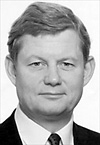
The United States and the European Union are closer on environmental issues than is generally perceived, Swedish business leader and environmentalist Jacob Wallenberg told an MIT audience on Sept. 9.
Delivering the annual Wallenberg Lecture on the Environment and Sustainability in room E25-111, Wallenberg said: "We do have some troubling differences of opinion today and I hope we can find ways to overcome them." His talk was titled "E.U. and U.S. - Not as Far Apart as You Think: The CEO's Global Challenge."
The Wallenberg Lectures are organized in connection with the Knut and Alice Wallenberg Foundation Postdoctoral Fellowship Program on Sustainability and the Environment. The fellowship program brings outstanding young Swedish scientists, engineers and policymakers to MIT for one to two years of study on environmental science, technology, policy and sustainable development.
In his lecture, Wallenberg acknowledged that the recent Johannesburg summit highlighted the differences in several areas, including climate change. Specifically, he referred to the U.S. refusal to approve the Kyoto Protocol.
"Despite our differences on Kyoto, the E.U. and the U.S. have nevertheless established a high-level dialogue on climate change and have agreed to collaborate on further research and monitoring," said Wallenberg, chair of the board of Skandinaviska Enskilda Banken (SEB) and vice chair of the Wallenberg Foundation.
He noted that the E.U. and the U.S. cooperated recently on technical issues related to air quality and chemical disposal and worked together on the Montreal Protocol for the Protection of the Ozone Layer, signed in 1987 and amended in 1992.
"The U.S. has also valuably assisted with projects in the Baltic Sea region - which Sweden is part of - in order to tackle the communist legacy of environmental damage, particularly from spent nuclear fuel and radioactive waste," he said.
Wallenberg urged both the E.U. and the U.S. to continue to pursue common objectives. "In the long term - on both sides of the Atlantic - that is the only route toward sustainable development," he said.
A version of this article appeared in MIT Tech Talk on September 18, 2002.