Challenged to design and build a Temple of Technology through which future generations might learn something of the tools and practices of 2002, nine students in the RISE summer program spent six weeks transforming their individual visions into three team-built works of art set in stone.
RISE (Research In Science and Engineering) was sponsored by NASA and hosted by MIT's Center for Bits and Atoms, which provided teaching and laboratory resources. MIT's Office of Minority Education administered the program on campus.
RISE, which ran from June 24 to Aug. 1, offered a "massive technology infusion" for students from historically black colleges and universities, said Professor of Mechanical Engineering Alexander H. Slocum, project leader for RISE.
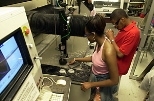
The students were strangers to one another and new to the tools they were using handily soon after their arrival. Collaborating in a flexible design process, using SolidWorks (a 3-D modeling system) and mastering the minivan-sized Abrasive Waterjet Machine - each phase of the creative process required new skills.
The results - meter-square marble portraits in which current technological symbols such as computer terminals and the space shuttle mix Escher-like with stars and human silhouettes - are striking for their intricacy and depth.
Most significant, said Slocum, is the students' participation in the program's larger goal: to "empower students to use the tools to design their own things."
The students, six men and three women, were sophomores and juniors majoring in physics, engineering or math at colleges and universities in the United States.
To see RISE team photos or for more information on the program, click here .
A version of this article appeared in MIT Tech Talk on August 14, 2002.