"EYE: Retinal Prints and Poetry by Elizabeth Goldring," an exhibition of works by a visually challenged artist whose sight is limited to light and shadow perception in one eye, is on view at the MIT Museum's Compton Gallery (Room 10-150) through Sept. 13. Goldring is a senior fellow at MIT's Center for Advanced Visual Studies .
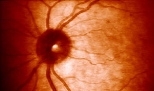
For the past several years, Goldring has experimented with the scanning laser ophthalmoscope (SLO), an imaging tool that delivers visual information to the retina and also records what the retina (and how the artist) sees. She records how she sees the world and creates visual images and poetry that have special meaning for individuals with little to no functional vision.
"For me, the retina prints are frozen traces of seeing turned into visual poems," she said. "The images 'sitting on my retina' are often only palpable through the SLO. Once seen and captured this way, they are always there in my mind's eye and on the retina prints."
"This exhibition highlights Goldring's pioneering work in images of the retina as art," said Beryl Rosenthal, director of exhibitions and programs. "Goldring's fascinating images and related poetry combine to form a powerful visual experience that will undoubtedly move art and poetry lovers of all types."
The poems included in the exhibition will be available to visually challenged visitors via an audio component. An exhibition catalog, "eye: poems & retina prints," published by BkMk Press at the University of Missouri in Kansas City, is available at the MIT Museum and in local bookstores.
A version of this article appeared in MIT Tech Talk on July 17, 2002.