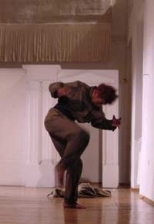
Internationally recognized Butoh artist Min Tanaka will perform a solo dance in the atrium of Building E15 at 7 p.m. on Wednesday, Dec. 12 in conjunction with the List Visual Arts Center's "YES Yoko Ono" exhibition.
Originating in Japan after World War II, Butoh is a contemporary avant-garde dance form combining dance, theater, improvisation and influences of traditional Japanese performing arts with German Expressionism. For his MIT performance, Tanaka will create unique movements to Yoko Ono's music.
Born in 1945, Tanaka grew up in suburban Tokyo, where he first studied and performed modern dance. In the early 1970s he began to dance independently, developing his original movement forms while participating in both solo and group performances. In 1985, he and the other members of Mai-juko, his company at the time, started the Body Weather Farm in the mountain village of Hakushu to explore the origin of dance through farming life.
In addition to the original Body Weather Farm where artists and dancers raise rice, vegetables and chickens, there are now two additional farms: one in Daitocho on the Pacific Coast and the other in Shikishima, facing Mt. Fuji. This farming village also houses the vast video and film collection of Dance Resources on Earth, a project Tanaka started in 1996 to establish a field museum for international folk and artistic dance resources. Tanaka is also founder and director of Tokason, a multinational dance group established in February 2000 to pursue the essence of Butoh.
Tanaka has danced in theaters, museums, streets, fields, gardens and rooftops around the world, and has collaborated with numerous artists and musicians. His Dec. 12 performance will be followed by a question and answer session. The List galleries will be open until 8:30 p.m. that day.
A version of this article appeared in MIT Tech Talk on December 5, 2001.