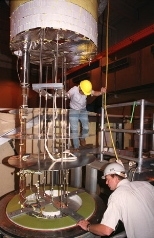
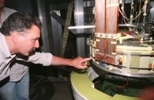
At the Plasma Science and Fusion Center, Dr. Chen Yu Gung (background, photo above), a research engineer, and project technician Richard Lations raise a high-field superconducting ring from a cryogenic chamber where it was tested successfully at its full design current, 1.57 million amperes. This test represented a major milestone in constructing the world's first Levitated Dipole Experiment (LDX), which will study the confinement of an ionized hydrogen gas, called plasma, in the field of a levitated dipole magnetic ring. This research is expected to evaluate the potential of a dipole-confined plasma for fusion energy. In the photo at right, Dr. Joseph Minervini, division head and principal research engineer, points to the superconducting windings of the Levitated Dipole Experiment (LDX) floating coil.
A version of this article appeared in MIT Tech Talk on August 9, 2000.