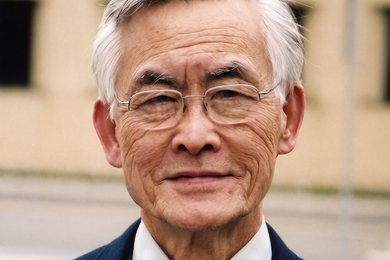
Professor of History Peter C. Perdue, a specialist in East Asian history, cultures and civilizations, has been appointed the first holder of the T.T. and Wei Fong Chao Professorship in Asian Civilizations.
Professor Perdue's research focuses on modern Chinese social and economic history. He has written numerous articles and a book on peasant societies and bureaucracies in China in the early modern period (Exhausting the Earth: State and Peasant in Hunan, 1500-1850, Harvard University Press, 1987). He is now completing another book on the Chinese conquest of Central Eurasia in the same period, and co-authoring a world history textbook titled Global Connections. He joined the MIT history section as an instructor in 1980 and served as its head from 1990-99.
"Peter Perdue is the senior scholar of East Asian studies at MIT," said Philip S. Khoury, dean of the School of Humanities, Arts, and Social Sciences and a professor of history. "His scholarship and teaching are not only of the very highest quality, but also are distinguished by an exceptional commitment to making Asian studies a central component of contemporary historical and theoretical discourse."
The Chao professorship was announced in October (see MIT Tech Talk, October 4, 2000). It is devoted to enhancing knowledge about East Asian cultures and societies with a particular emphasis on Buddhism as a philosophy and religion, and was set up to honor a distinguished scholar and teacher in the field. A key feature of the professorship is new curriculum development designed to take advantage of cross-disciplinary scholarship.
A version of this article appeared in MIT Tech Talk on November 15, 2000.