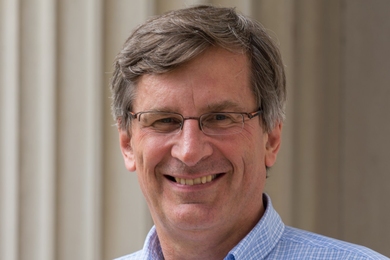
"Xenotransplantation: Cure or Cataclysm," this year's annual STS-sponsored Arthur Miller Lecture on Science and Ethics, will be delivered by Dr. Fritz H. Bach on Monday, May 3 at 4pm in Bartos Theater (Building E15).
Dr. Fritz H. Bach, a world expert on immunobiology and transplantation, is the Lewis Thomas Professor at Harvard Medical School and director of the Immunobiology Research Center at Beth Israel Deaconess Medical Center. He has made major contributions in studying and testing for tissue compatibility between donors and recipients of organs and bone marrow.
In his talk, Dr. Bach will discuss how xenotransplantation of porcine (pig) organs to humans would relieve the enormous organ shortage, allowing patients in need of transplants to receive them. However, there are still significant rejection problems to overcome before xenotransplantation can be considered as a clinical intervention. Transplantation of porcine organs to humans also carries the risk that a porcine virus would infect the recipient of the transplant, mutate and cause another AIDS-like epidemic. This risk requires that an informed public be involved in deciding whether xenotransplantation should go forward, and if so, under what conditions.
Dr. Miller was an MIT alumnus (SB 1945) noted for his work in electronic measurement and instrumentation. During World War II, he was loaned out by the Sanborn Co. (later incorporated into Hewlett-Packard) to the Radiation Lab, where he worked for several years. His medical contributions included methods to reduce shock hazards in hospital monitoring systems, and designing the first commercial cardiographs that featured adequate patient circuit isolation from line and ground.
The talk is free and open to the public. For more information, call Debbie Meinbresse at x3-4062.
A version of this article appeared in the April 28, 1999 issue of MIT Tech Talk (Volume 43, Number 28).