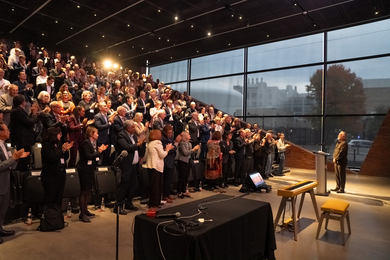
One hundred ambassadors of the digital generation will deplane at Logan Airport in Boston on November 15, bound for MIT.
Arriving from 54 different countries, the ambassadors, ages 10-16, were delegated by their peers to participate in Junior Summit '98, a six-day conference hosted by the Media Lab. The Junior Summit began a year ago with the Media Lab's global invitation to almost one million young people to describe their current world and to suggest ways technology might be used to improve that world.
Last month, nearly 3,000 participants from 139 countries began communicating with one another through an on-line forum. Utilizing translation technology, they have been sharing their views across geographic and cultural barriers.
The 100 delegates arriving at MIT are bringing their ideas, plans and solutions to some of the world's most pressing problems -- issues all participants have been discussing through the global on-line forum.
During the summit, the delegates will develop innovative approaches and solutions which will have far-reaching results. Anticipated outcomes include the development of a junior world bank; a children's bill of rights; an organized press corps run by young people around the world; an idea bank; and a means by which youth can directly work with governments, particularly relating to the uses of technology.
The final deliberations of Junior Summit '98 will be presented to a distinguished audience of international government, business, civic and religious leaders on November 21 at MIT.
The summit is made possible by the support of Citibank, the LEGO Group and Swatch. For more information, see the Junior Summit '98 web site.
A version of this article appeared in MIT Tech Talk on October 28, 1998.