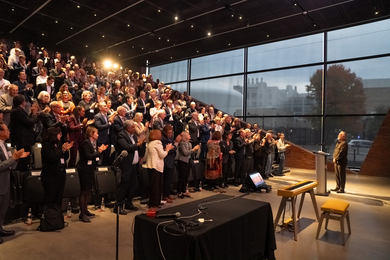
Associate Professor Mitchel Resnick will give a talk on "Toys To Think With," the next installment in the Media Lab's Perspectives Series, on Tuesday, Feb. 24 from 5-6pm in Bartos Theater (Building E15).
Toys have always played an important role in children's learning. For example, simple building blocks enable children to explore important mathematical concepts such as number, shape and size. In his talk, Professor Resnick will discuss and demonstrate a new generation of digital toys that can engage children in explorations of concepts such as feedback, emergence, and probability that were seen as "too advanced" for children in the pre-digital era.
Professor Resnick, the Fukutake Career Development professor of Research in Education, has developed a variety of educational tools, including LEGO/Logo (a computer-controlled construction kit) and StarLogo (an environment for modeling decentralized systems). He is co-founder of the Computer Clubhouse, an after-school learning center for youth from underserved communities. He worked for five years as a science/technology journalist for Business Week magazine, and he is author of Turtles, Termites, and Traffic Jams (MIT Press, 1994).
A version of this article appeared in MIT Tech Talk on February 11, 1998.