MAGLEV FOR CHIPS
MIT technology could double the speed of etching still finer integrated circuits onto the silicon wafers that will become computer chips.
Semiconductor equipment typically uses air bearing stages that move silicon wafers through the integrated circuit production process. Now Associate Professor David Trumper of the Department of Mechanical Engineering has developed a promising technology for replacing these air bearing stages with a much faster and more precise magnetic bearing stage.
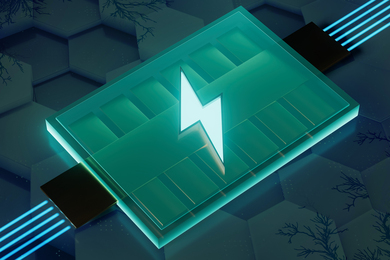
Unlike the slower air bearing stages that require separate components for vertical and horizontal movement of the silicon wafer, Professor Trumper's magnetic version handles both vertical and horizontal positioning of silicon wafers. It does so by using a magnetic field to levitate and move the wafer with nanometer resolution while requiring no mechanical contact between the stage and any part of the photolithography machine. This means that the stage produces no friction or wear on the mechanisms.
"The dominant advantage, however, is that you can position the wafer in multiple degrees of freedom with only a single moving part," said Professor Trumper.
The work is sponsored by Ultratech/Integrated Solutions and by the National Science Foundation. (Source: The MIT Report)
A version of this article appeared in MIT Tech Talk on December 16, 1998.