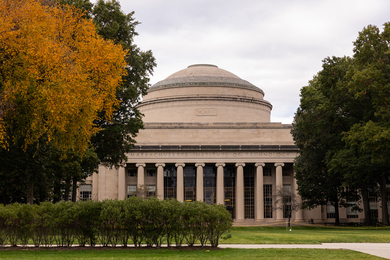
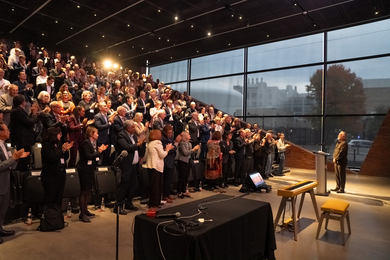
Its official name is (Art x Media) music but Media Lab denizens are calling it "Cubestock" in deference to the location of the extravaganza. In a last hurrah before renovations temporarily close "the Cube"--the Philippe Villers Experimental Media Facility (E15, lower level)--Media Lab students are using the space for an arts festival on Friday, May 29 from 7pm-midnight.
The festival will feature music, art and multimedia endeavors both inside and outside the scope of Media Lab research. Students will present high-tech, interactive computer-generated projects as well as more traditional photography, paintings and musical performances.
"We usually present demonstrations to corporate sponsors, but not to the rest of MIT," said organizer Pete Rice, a Media Lab graduate student. "We wanted to find a different way to show our work."
Live musical performances will be presented by Liv���sexact, an electronic audiovisual performance trio made up of graduate students Stefan Agamanolis, Freedom Baird and Alex Westner. Using synthesizers, an electronic wind instrument and homemade drum kits made with stuffed animals and ironing boards, the group plays music they describe as "technopunk dance" synchronized with video clip projections.
"Stretchable Music," to be demonstrated by its creator Mr. Rice, is a graphic-based interactive music installation that he says looks more like a video game than a traditional musical instrument. "Players" use game controllers to manipulate graphical objects on the screen that represent different layers of a piece of music.
Multimedia installations include it was, a reworking of an experimental computerized theater piece called It/I by graduate student Claudio Pinhanez that was performed last November. Props, screens, backdrops, and video and audio excerpts from the original play are used to examine the possible meanings of death for a computer creature.
"Grassterscan," created by electrical engineering and computer science graduate student Joshua Strickon, displays images of grass and animations accompanied by sound. It is, he says, "the world's first pixellated agricultural display."
For more information, contact Pete Rice at x3-9306 or pwrice@media. mit.edu, or Alex Westner at x3-0312 or westner@media.mit.edu.
A version of this article appeared in MIT Tech Talk on May 20, 1998.