Skip to content ↓

Program launch (caption)

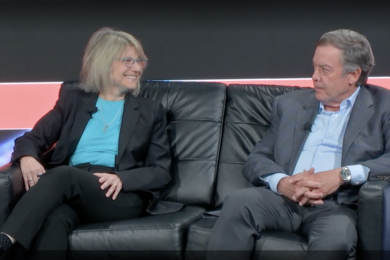
Team members of the new National Space Biomedical Research Institute, established by NASA to study medical obstacles associated with long-term human presence in space, recently assembled at MIT to mark the success in winning NASA's sponsorship. Left to right: team leaders Dr. Charles M. Oman, a senior lecturer in aeronautics and astronautics and director of the Man-Vehicle Laboratory; Dr. Richard J. Cohen, professor in the Harvard-MIT Division of Health Sciences and Technology and director of the Biomedical Engineering Center; Dr. Charles Szeisler of Harvard Medical School and Brigham and Women's Hospital, and NSBRI director Laurence R. Young, Apollo Program Professor of Astronautics.


A version of this article appeared in MIT Tech Talk on April 3, 1997.
Related Topics

More MIT News

Globular blue and white orbs "examining" single-stranded RNA products and marking them with green checks or red x's

Why are some bacterial genes high in purines?

In certain species of bacteria, the answer lies in shielding RNA transcripts from a quality-control factor called Rho. Understanding the requirements for expressible sequences is critical for expression engineering of therapeutic agents.

Read full story

Rich Nielsen, Volha Charnysh, Kevin Dorst, and Emily Richmond Pollock seated at a table, talking

Building a scholarly community

The SHASS Faculty Fellows Program, administered by the MIT Human Insight Collaborative, is fostering new research projects and creating space for supportive and interdisciplinary discussion.

Read full story