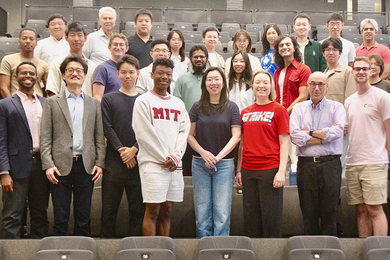
Nine departmental awards in nuclear engineering were announced at the department's International Banquet last month.
The Ruth and Joel Spira Award for distinguished teaching was presented to Professor Sidney Yip in recognition of "the tradition of high quality engineering education at MIT."
Dr. Lisa J. Porter, a postdoctoral associate, was the recipient of the American Nuclear Society (ANS) Student Chapter outstanding teaching award.
Ju Li, a graduate student from China, received the Manson Benedict Fellowship in recognition of excellence in academic performance and professional promise.
The Sherman Knapp Fellowship of Northeast Utilities is given to an outstanding graduate student who plans to pursue a career in nuclear power engineering. This year's recipient was Gary S. Cerefice, a graduate student from Naperville, IL.
Seungtaek L. Choi, a senior from Huntington Beach, CA, received the Roy Axford Award for outstanding achievement by a senior. The Irving Kaplan Award, which recognizes academic achievement by a junior, was presented to Jerry W. Hughes Jr. of Douglasville, GA.
Kathryn E. Hautanen, a graduate student from West Yarmouth, MA, and Theodore J. Weber, a senior from Paso Robles, CA, received Outstanding Student Service Awards.
It was also noted that Heather MacLean, an incoming graduate student from Madison, WI, is the recipient of an Ida Green Fellowship.
A version of this article appeared in MIT Tech Talk on June 5, 1996.