MIT has announced the establishment of a six-year scientific collaboration between the School of Science and Italy's National Institute for Nuclear Physics (INFN). The agreement includes graduate fellowships honoring Bruno Rossi, the late Italian physicist and MIT faculty member who played an important role in shaping the MIT Department of Physics after World War II.
Dr. Rossi, who died November 21, 1993, at the age of 88, was a leader in the scientific exploration of space. He led efforts that resulted in the discovery of cosmic X-rays and was a key participant in pioneering investigations of the interplanetary medium.
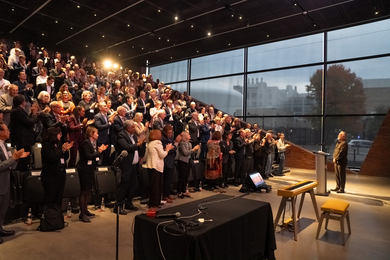
The agreement of collaboration between MIT and INFN was signed Friday, May 6, by Dean of Science Robert J. Birgeneau and Professor Luciano Maiani, president of INFN. It formalizes a long-standing collaboration in theoretical nuclear and particle physics between the MIT Center for Theoretical Physics and Italian scientists at the faculty, postdoctoral and graduate levels.
Every two years, fellowships will be made available for Italian students to pursue the PhD degree in physics at MIT. INFN will support those students for the first two years and MIT for the second two years through the Department of Physics and the Laboratory for Nuclear Science.
In addition, INFN will support each year an Italian theoretical physicist at MIT at the postdoctoral level. The collaboration further provides for faculty exchanges between MIT and INFN.
A four-member coordination committee of MIT and INFN will oversee implementation. The first Rossi Fellows will enroll at MIT in the fall.
A version of this article appeared in the May 11, 1994 issue of MIT Tech Talk (Volume 38, Number 32).