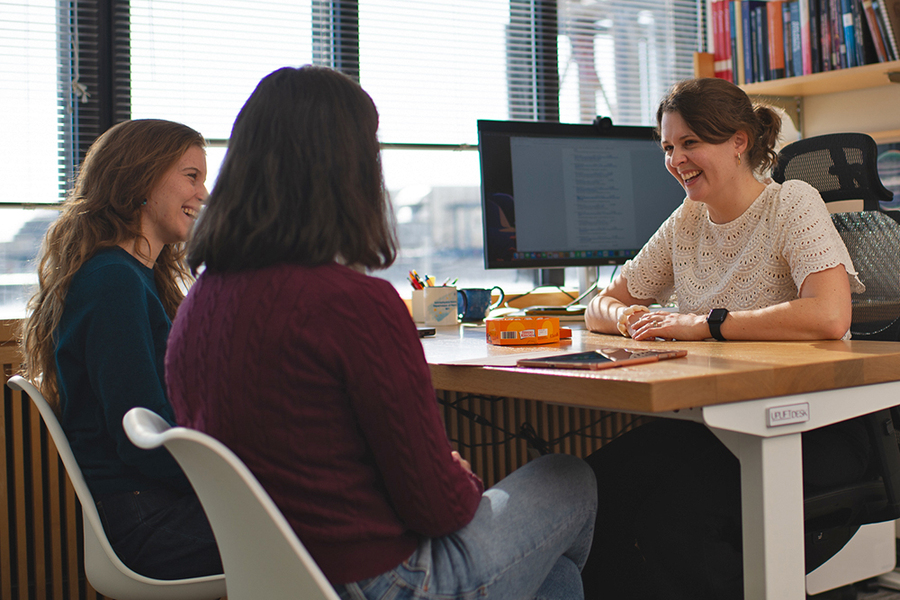
In Professor Anna-Christina Eilers’ research group, mentorship happens through small, meaningful gestures: thoughtful feedback on a draft, a check-in after a rough week, and a readiness to help when things get tough. For her students, these everyday moments have become a defining feature of her approach.
An observational astrophysicist, Eilers studies how the universe evolved from its earliest beginnings. Her research investigates the formation and growth of black holes across cosmic time, particularly during the “cosmic dawn,” when the first stars, galaxies, and quasars illuminated the young universe.
Working alongside her in this field, graduate students describe a mentor who pairs high expectations with genuine attentiveness, encouraging both scientific independence and a strong sense of community. This approach has earned Eilers recognition through MITs Committed to Caring initiative — a student-driven program honoring exemplary mentorship within the graduate community.
Showing up in the everyday moments
Students say one of Eilers’ defining qualities is her consistency. No matter how busy her schedule, they know they can count on thoughtful feedback, productive meetings, and regular conversations about both research and broader career development. While those practices may sound routine, her mentees emphasize that they are anything but guaranteed within many academic spaces.
“As Christina's advisees,” two students wrote in their joint nomination, “we are both extremely grateful for the professional and emotional support we constantly receive. She always keeps an eye out for us.”
Eilers’ support takes many forms. Students describe an advisor who carefully reads every draft, provides timely and detailed feedback, and creates space for conversations that extend beyond immediate research questions.
Students also reflect on the manner in which Eilers celebrates their wins alongside them. “She brings our favorite desserts to group meetings when we publish a paper,” shared one nominator.
Her attentiveness becomes especially meaningful when challenges arise. Students note that she regularly checks in on them and does not hesitate to step in when research collaborations become difficult or obstacles threaten to slow their progress. Rather than leaving them to navigate those situations alone, she helps identify solutions before small problems become larger ones.
For Eilers, building a successful research group means cultivating connections among its members as well as producing strong science.
One of the group’s traditions takes place whenever a member returns from a conference or research visit. The traveler brings back a small treat — cookies, chocolates, or another local specialty — to share during the next group meeting. Along with the snacks comes a conversation about the talks they attended, the researchers they met, and the ideas they brought home.
The tradition transforms an individual trip into a shared opportunity for learning, with new perspectives becoming part of the group’s collective conversation. These exchanges work to not only reinforce a sense of community, but also to expose students to research and ideas beyond their own projects.
Through moments like these, students develop both as researchers and as colleagues who celebrate one another’s successes and learn from one another's discoveries.
Remembering the person behind the researcher
One of Eilers’ most consistent pieces of advice has little to do with coursework or research.
“I always recommend to incoming graduate students to find a hobby outside of work that they enjoy, and ideally where they interact with people they don’t work with,” she says.
She believes maintaining interests beyond the lab helps students sustain both their curiosity and their perspective. “Graduate school can be all-consuming,” she says, reflecting on her own experiences. “It's easy to let your research become your entire identity.”
This same philosophy shapes her mentorship: successful researchers are also people with lives, relationships, and interests beyond their work. Making space for those parts of life helps students build careers that are both ambitious and sustainable.
Eilers traces her approach to the advisors who shaped her own career.
“I was very fortunate to have had — and continue to have — several mentors who have challenged me scientifically and supported me along the way," she says. “They modeled how to pursue excellent research without losing sight of the importance of personal connection and integrity.”
Her students see these values reflected within the group environment. They are encouraged to tackle ambitious questions while developing the confidence to think independently, but they know that guidance is available when they need it.
In their nominations of Eilers, students describe an advisor who is present in both the ordinary and the difficult moments — someone who notices when support is needed, advocates for her students, celebrates their successes, and builds a community where students consistently feel seen.
Through this steady commitment, Eilers demonstrates that care is not separate from academic excellence. Rather, it creates the conditions that allow excellence to flourish.