Skip to content ↓

A baseball-sized sensor can detect chemical threats

The “TOSSIT” device, developed at MIT Lincoln Laboratory, can warn service members and first responders of dangerous vapors and aerosols.
Watch Video

Press Contact:

David
R.
Granchelli
Phone:
781-981- 4204
MIT Lincoln Laboratory
Close
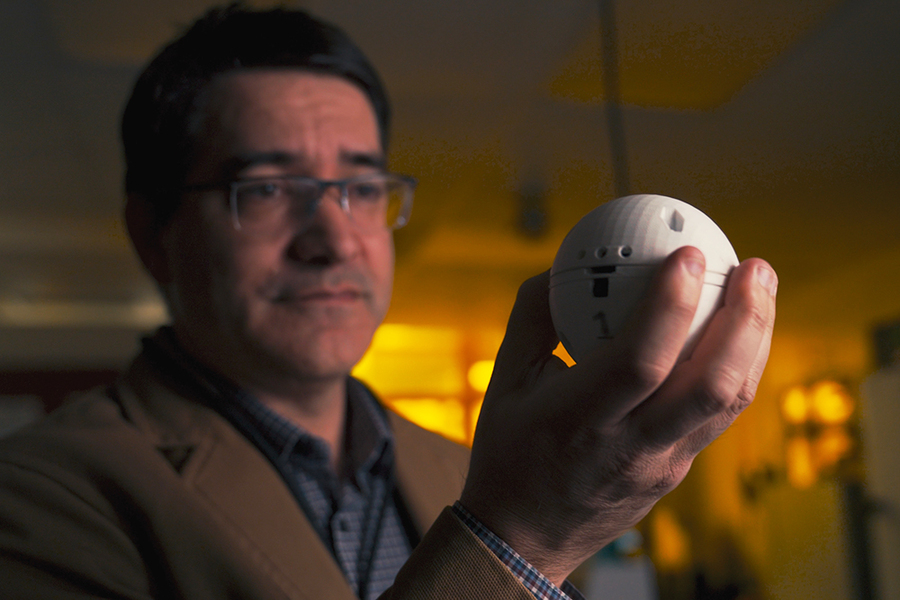
In a darkened lab, Jude Kelley holds up a white baseball-sized spherical sensor
Caption:
Researcher Jude Kelley holds up TOSSIT, an alerting sensor with a removable dye card that changes color in response to chemicals in the air.
Credits:
Image: Tim Briggs

Researchers at MIT Lincoln Laboratory have designed a throwable, baseball-sized sensor that can remotely detect hazardous vapors and aerosols. 

Called the Tactical Optical Spherical Sensor for Interrogating Threats (TOSSIT), the sensor is designed to alert military service members, first responders, and law enforcement to the presence of chemical threats like nerve and blister agents, industrial chemical accidents, or fentanyl dust. 

Users can simply toss, drone-drop, or launch TOSSIT into an area of concern. To detect chemicals, the sensor samples the air and uses an internal camera to observe color changes on a removable dye card.

If certain chemicals are present, TOSSIT alerts users via an app or alarms in the sensor.

Video thumbnail Play video
Tossing TOSSIT to detect chemical threats
Video: MIT Lincoln Laboratory

"TOSSIT fills an unmet need, providing a low-cost sensing option for vapors and solid aerosol threats — think toxic dust particles — that would otherwise not be detectable by small deployed sensor systems,” says principal investigator Richard Kingsborough.

After extensive testing in the field, the technology is being transferred to the U.S. military.
Related Links

Related Topics

Related Articles

More MIT News

Jonathan Gruber, David Kaiser, and Heather Paxson

Podcast: SHASS’s special sauce

Established after World War II, the School of the Humanities, Arts, and Social Sciences is an integral part of the MIT experience. Three faculty reflect on the school’s ongoing impact.

Read full story

Marina Milea poses, standing, in a colorfully painted hallway

Finding purpose through research

This summer, BSG-MSRP-Bio student Marina Milea investigated how lung cancers become resistant to targeted therapies, gaining hands-on research experience in the Jacks Lab at the Koch Institute.

Read full story