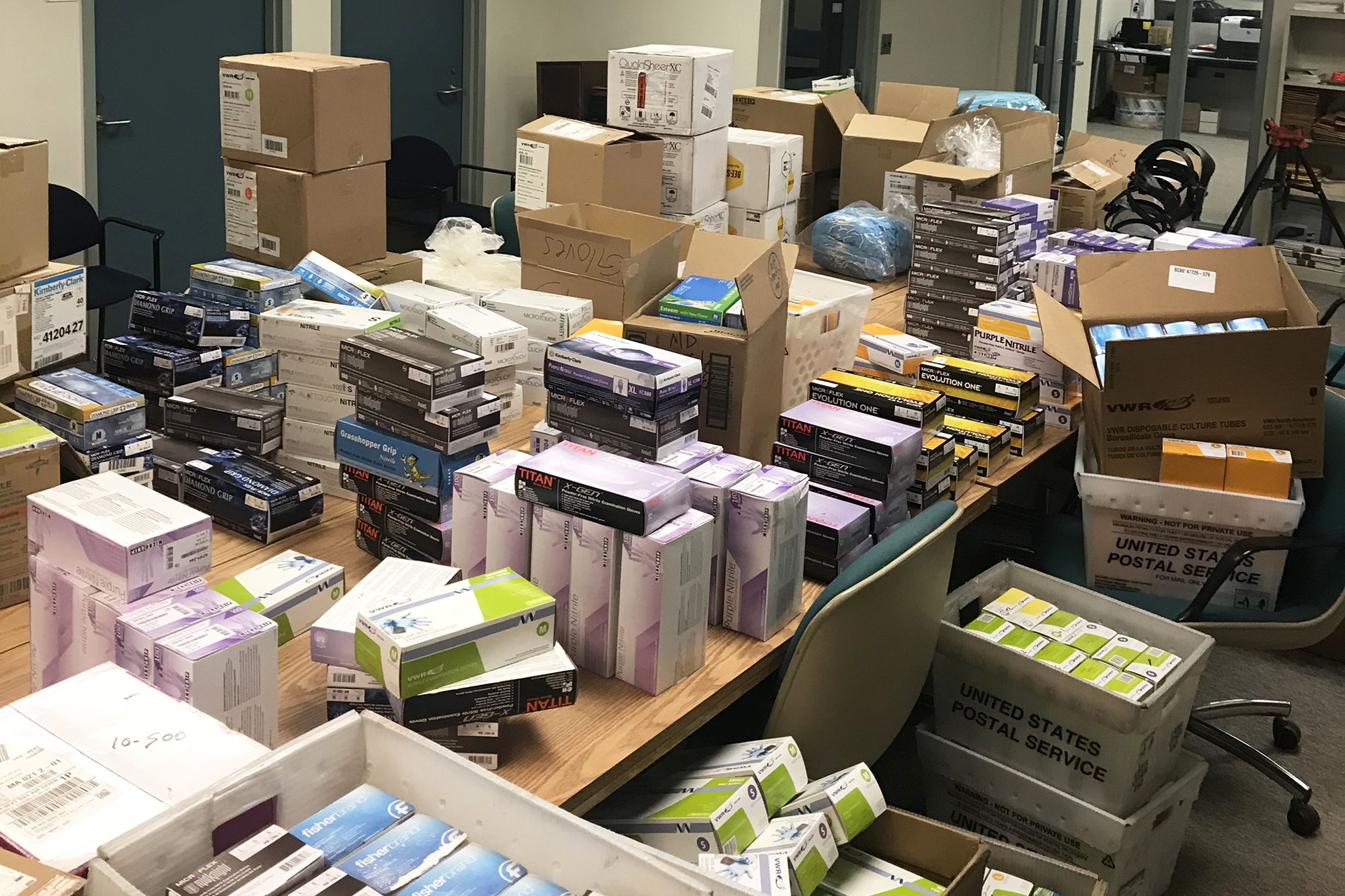
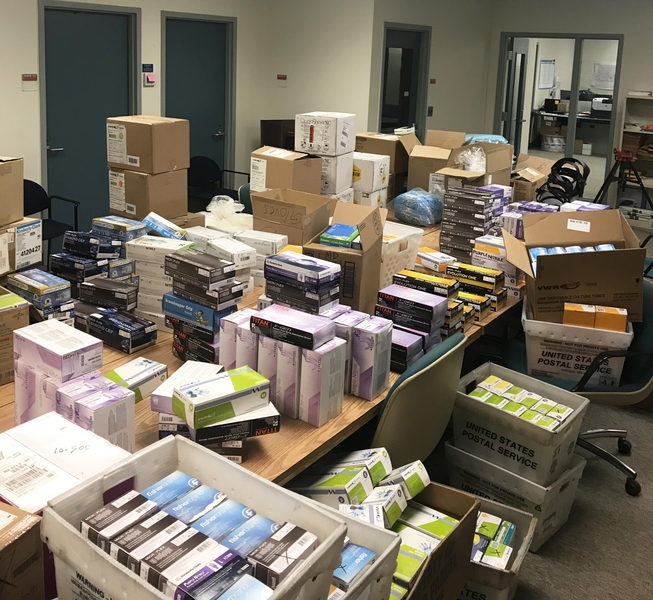
While much of the MIT campus is quiet, Mail Services has seen a steady stream of activity this week as it acts as the staging and sorting area for thousands of donated Personal Protective Equipment (PPE) from across campus.
More than 50 departments, labs, and centers — as well as individual community members — have responded to a call to donate extra, unopened PPE to support area hospitals and frontline health care workers in need. Some labs even included handwritten notes of thanks and support on their donation.
A cross departmental effort has allowed for a quick response to an outpouring of donations: Mail Services and Custodial Services have collected donated PPEs from across campus, while Campus Services Senior Manager Marty O’Brien; Environment, Health, and Safety Associate Director Nick Paquin; and Office of Sustainability Project Manager Steve Lanou have worked to sort and inventory items as they come in. O’Brien, along with Mail Services Supervisor Darren O’Connor and Manager Mike Fahie, have to date delivered donations to area hospitals including Cambridge Health Alliance and Beth Israel Deaconess Medical Center, as well as to the Cambridge Police and Fire Departments. Additional distribution to area hospitals is planned.
As these donations go out, Professor Elazer R. Edelman, faculty lead on this effort and the director of the Institute for Medical Engineering (IMES), notes that hospitals still remain in acute need of PPE, and are specifically in need of unopened and unused face masks including clinical and surgical; face shields; gloves; powered air-purifying respirators; gowns; cleaning wipes with bleach; hand sanitizers; swabs including Dacron, rayon, or nylon swabs; and culture media. Labs with any of these items in any quantity are encouraged to email donate-ppe@mit.edu to arrange collection.
While the handling of these donations focuses on collecting available PPE for rapid distribution, another PPE team is organizing efforts across campus to consider manufacturing and sterilization solutions. The PPE manufacturing team can be reached at manufacture-ppe@mit.edu.