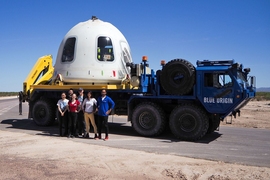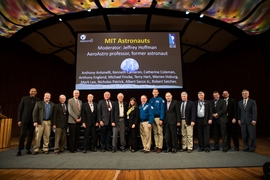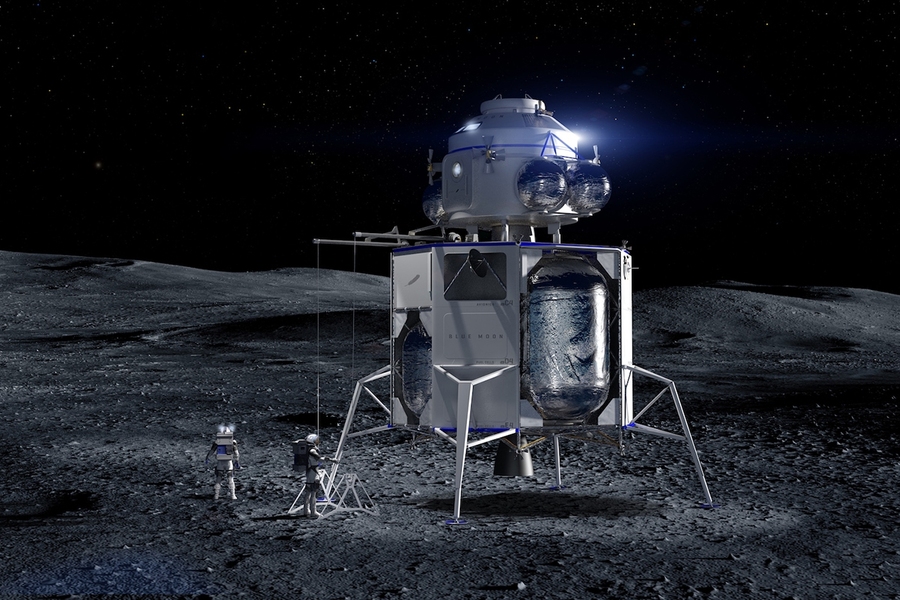
MIT and Blue Origin have signed a memorandum outlining plans to pursue mutual interests in space exploration. MIT will develop one or more payload experiments to be launched aboard Blue Origin’s Blue Moon, a flexible lander delivering a wide variety of small, medium, and large payloads to the lunar surface.
MIT Apollo Professor of Astronautics and former NASA Deputy Director Dava Newman, who developed the agreement with Blue Origin, says that over the coming months, MIT researchers will invite input from the MIT community to help determine the nature of the flight opportunity experiment. “Some potential areas include smart habitats, rovers, life support and autonomous systems, human-machine interaction, science of the moon, lunar poles, sample return, and future astronaut performance and suit technologies,” Newman says.
Blue Origin’s business development director, A.C. Charania, has said the company’s lunar transportation program is its “first step to developing a lunar landing capability for the country, for other customers internationally, to be able to land multimetric tons on the lunar surface.” Blue Moon payloads could include science experiments, rovers, power systems, and sample return stages.
MIT has a long history of aerospace engineering development and lunar science related to space exploration, including receiving the first major contract of the Apollo program, which involved the design and development of the lunar missions’ guidance and navigation computers. MIT experiments have flown on Space Shuttle missions, and been conducted aboard Skylab, Mir, and the International Space Station. MIT also led the GRAIL (Gravity Recovery And Interior Laboratory) mission to explore the moon’s gravity field and geophysical structure.