Skip to content ↓

Students invade Killian Court for epic water war

Water war is an MIT tradition that pits residents from East Campus and West Campus against each other during Residential Exploration.
Watch Video

Press Contact:

Stephanie Tran
Phone: 617-253-6927
Close
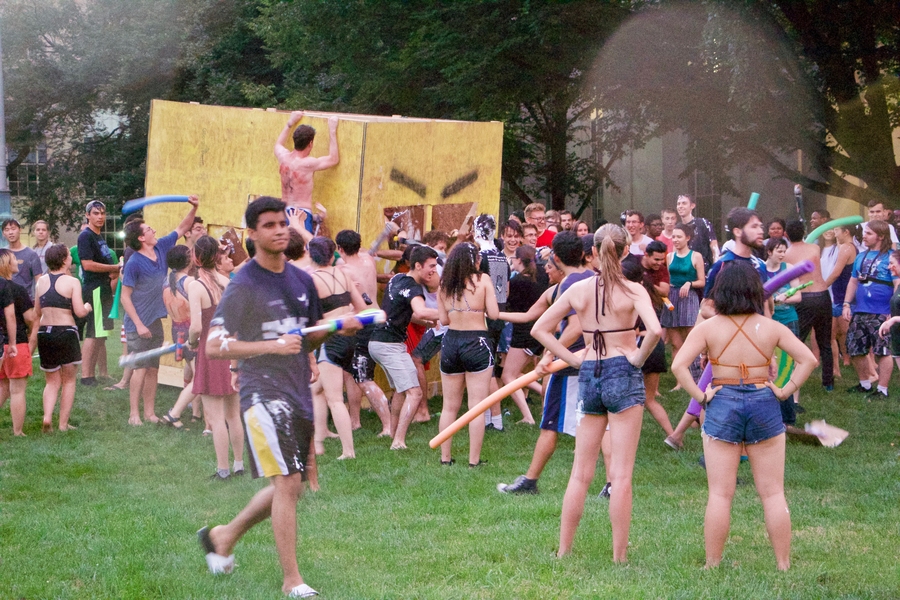
MIT students mob the coveted Trojan Duck, which was created by residents of Simmons Hall.
Caption:
MIT students mob the coveted Trojan Duck, which was created by residents of Simmons Hall.
Credits:
Image courtesy of DSL Communications
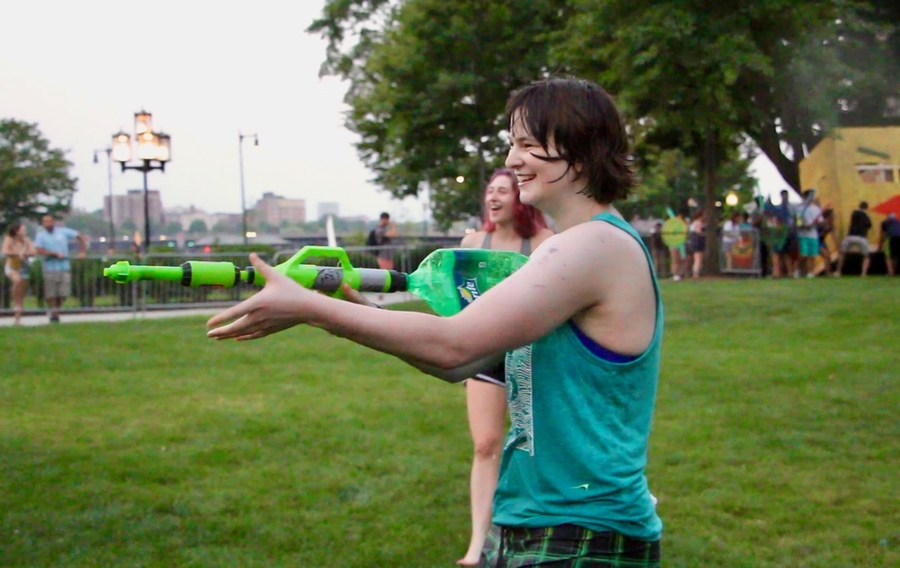
Students battle it out with good old H2O during the annual water war on Killian Court.
Caption:
Students battle it out with good old H2O during the annual water war on Killian Court.
Credits:
Image courtesy of DSL Communications

New and returning students cooled off from the late-summer heat by waging the Institute's annual water war — an MIT tradition that began in the early 2000s and is an official part of Residential Exploration (REX). The invasion pits residents from East Campus and West Campus for ultimate bragging rights.

Preparation for the battlefield is no joke. Students spent days filling up water balloons, designing shields, building the coveted Trojan Duck, and more for their Aug. 28 faceoff.

As dusk approached, chanting and the sounds of vuvuzelas could be heard echoing from a distance as residents from East Campus and West Campus marched onto Killian Court — signaling the imminent water battle. Once the troops were assembled on each side, REX Chairs convened in the middle for their traditional handshake and announced the official start of war. Within seconds, students armed for battle ran towards each other and a massive explosion of water balloons ensued.

Despite their intensity, water wars usually only last for 10 minutes or so before a ceasefire is called. No victor is ever officially declared, but there is always a sure winner. Who that is depends on which side you ask.
Related Links

Related Topics

Related Articles

More MIT News

Rich Nielsen, Volha Charnysh, Kevin Dorst, and Emily Richmond Pollock seated at a table, talking

Building a scholarly community

The SHASS Faculty Fellows Program, administered by the MIT Human Insight Collaborative, is fostering new research projects and creating space for supportive and interdisciplinary discussion.

Read full story

Globular blue and white orbs "examining" single-stranded RNA products and marking them with green checks or red x's

Why are some bacterial genes high in purines?

In certain species of bacteria, the answer lies in shielding RNA transcripts from a quality-control factor called Rho. Understanding the requirements for expressible sequences is critical for expression engineering of therapeutic agents.

Read full story