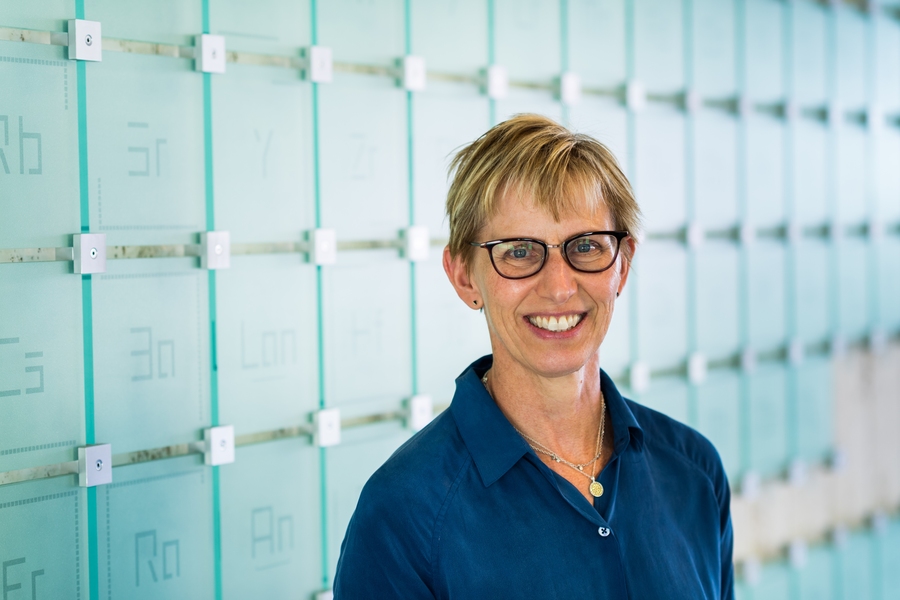
Elsevier and the board of executive editors of the Tetrahedron journal series have selected MIT Professor Laura L. Kiessling as the recipient of the 2017 Tetrahedron Prize for Creativity in Organic Chemistry for her outstanding contributions to the field. She is the first woman to be chosen for this illustrious award, and joins an impressive list of fellow winners, including several Nobel laureates.
“Hearing about the Tetrahedron Prize was both surprising and special," Kiessling said. "The previous winners are a list of those who have inspired me, including my mentors Stuart Schreiber and Peter Dervan. This honor is also important to me as it recognizes a change in the diversity of researchers in organic and bioorganic chemistry, and diversifying our field is critical for its vitality.”
Professor Stephen Martin, chair of the editorial board of Tetrahedron journals, said on announcing this year’s winner, “Professor Kiessling has performed truly ground-breaking research in the broad field of chemical glycobiology, an important field she has played a major role in shaping. Using creative chemical strategies to interrogate and elucidate cellular pathways involving glycans is a hallmark of her work. Her creative contributions to diverse areas ranging from exploring glycan synthesis in mycobacteria to probing mechanisms of differentiation in human stem cells have had a profound influence in chemical biology.”
The Tetrahedron Prize for Creativity in Organic Chemistry was established in 1980 by the executive board of editors and the publisher of Tetrahedron Publications. The award is intented to honor the memory of the founding co-chairmen of these publications, Professor Sir Robert Robinson and Professor Robert Burns Woodward. It is awarded annually in recognition of creativity in organic chemistry or bioorganic and medicinal chemistry, and will be presented during the 2018 Fall National Meeting of the American Chemical Society, which will be held in Boston next August.
Kiessling’s interdisciplinary research interests focus on elucidating and exploiting the mechanisms of cell surface recognition processes, especially those involving protein-glycan interactions. Another major research interest is multivalency and its role in recognition, signal transduction, and direction of cell fate.