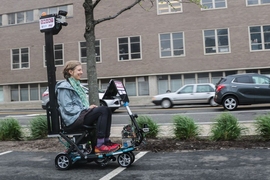
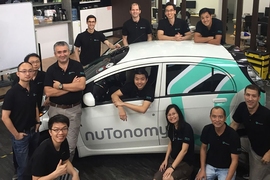
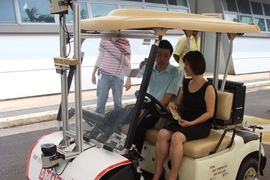
Singapore and MIT have been at the forefront of autonomous vehicle development. First, there were self-driving golf buggies. Then, an autonomous electric car. Now, leveraging similar technology, MIT and Singaporean researchers have developed and deployed a self-driving wheelchair at a hospital.
Spearheaded by Daniela Rus, the Andrew (1956) and Erna Viterbi Professor of Electrical Engineering and Computer Science and director of MIT’s Computer Science and Artificial Intelligence Laboratory, this autonomous wheelchair is an extension of the self-driving scooter that launched at MIT last year — and it is a testament to the success of the Singapore-MIT Alliance for Research and Technology, or SMART, a collaboration between researchers at MIT and in Singapore.
Rus, who is also the principal investigator of the SMART Future Urban Mobility research group, says this newest innovation can help nurses focus more on patient care as they can get relief from logistics work which includes searching for wheelchairs and wheeling patients in the complex hospital network.
"When we visited several retirement communities, we realized that the quality of life is dependent on mobility. We want to make it really easy for people to move around," Rus says.
Submitted by: Pauline Teo/SMART | Video by: SMART | 3 min, 3 sec