Skip to content ↓

Jonathan How named AIAA Fellow

MIT professor and engineer honored for significant contributions to the field of aeronautics.

Press Contact:

William Litant
Phone: 617-253-1564
Dept. of Aeronautics and Astronautics
Close
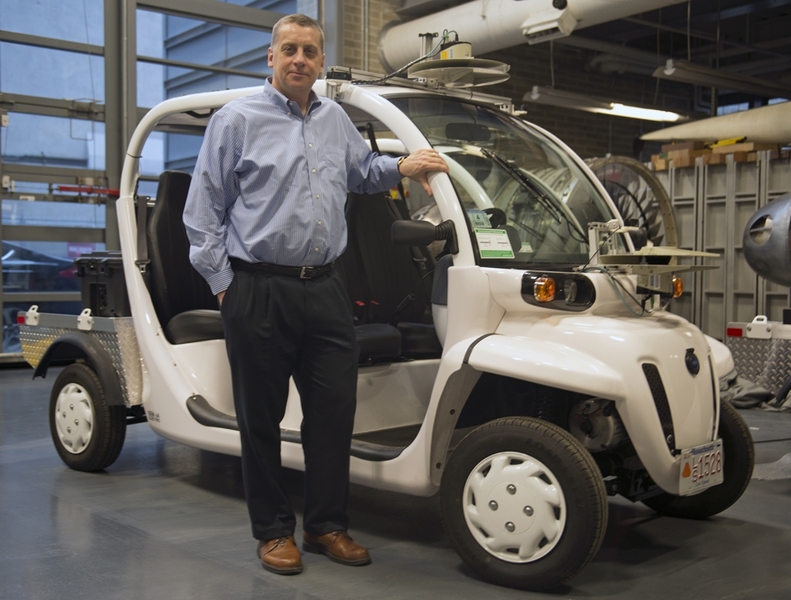
Professor Jonathan How has been selected a fellow of the American Institute of Aeronautics and Astronautics. He’s pictured here with vehicles that the Aerospace Controls Laboratory is using to investigate algorithms for predicting pedestrian motion patterns — a critical function for future mobility on demand systems and self-driving cars.
Caption:
Professor Jonathan How has been selected a fellow of the American Institute of Aeronautics and Astronautics. He’s pictured here with vehicles that the Aerospace Controls Laboratory is using to investigate algorithms for predicting pedestrian motion patterns — a critical function for future mobility on demand systems and self-driving cars.
Credits:
Photo: William Litant

Jonathan P. How, the Richard C. Maclaurin Professor of Aeronautics, has been elected a fellow of the American Institute of Aeronautics and Astronautics (AIAA), the world’s largest aerospace professional society.

Edward Greitzer, the H.N. Slater Professor of Aeronautics and Astronautics at MIT and an AIAA Honorary Fellow, said, “Election as an AIAA Fellow is among the highest honors bestowed by the aerospace community. It recognizes Jon’s exceptional contributions to the field, both nationally and internationally.”

How heads the MIT Aeronautics and Astronautics Department’s Information Sector. He is director of the Ford-MIT Alliance, and is a member of the United States Air Force Scientific Advisory Board. He is editor-in-chief of the IEEE Control Systems Magazine and an associate editor for the AIAA Journal of Aerospace Information Systems.

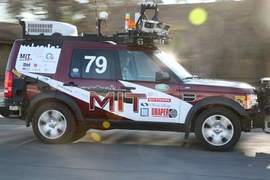
How was the planning and control lead for the MIT team that placed fourth in the 2007 DARPA Urban Challenge. His research encompasses design and implementation of distributed robust planning algorithms to coordinate multiple autonomous vehicles in dynamic uncertain environments; sensor fusion and navigation; aerial robotics and agile flight; and planning and learning for real-time autonomous mechanical and aerospace applications. 

Following receipt of his MIT doctorate in 1993, How studied at the Institute for two years as a postdoc working on the Middeck Active Control Experiment (MACE) that flew onboard the Space Shuttle Endeavour in March 1995. Prior to joining the MIT faculty in 2000, he was an assistant professor in the Department of Aeronautics and Astronautics at Stanford University.
Related Links

Related Topics

Related Articles

More MIT News

Rich Nielsen, Volha Charnysh, Kevin Dorst, and Emily Richmond Pollock seated at a table, talking

Building a scholarly community

The SHASS Faculty Fellows Program, administered by the MIT Human Insight Collaborative, is fostering new research projects and creating space for supportive and interdisciplinary discussion.

Read full story

Globular blue and white orbs "examining" single-stranded RNA products and marking them with green checks or red x's

Why are some bacterial genes high in purines?

In certain species of bacteria, the answer lies in shielding RNA transcripts from a quality-control factor called Rho. Understanding the requirements for expressible sequences is critical for expression engineering of therapeutic agents.

Read full story