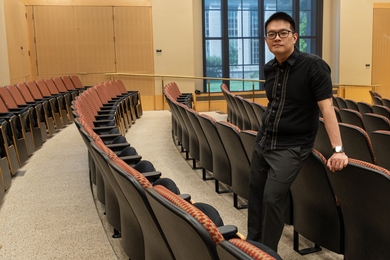
P. Christopher Zegras has been named the lead principal investigator for the Future of Urban Mobility Interdisciplinary Research Group at the Singapore-MIT Alliance for Research and Technology (SMART).
An associate professor in the MIT Department of Urban Studies and Planning, Zegras researches sustainable mobility from the standpoints of human behavior, strategic planning and policy, finance, and implementation, and he heads the Mobility Futures Collaborative at MIT.
The mission of the Future of Urban Mobility group, or SMART FM, is to develop, in and beyond Singapore, new paradigms for the planning, design and operation of future urban mobility systems that simultaneously tackle two opposing objectives:
- to improve the safety, comfort, and time associated with transportation, getting individuals and goods where they need to be, when they need to be there; and
- to reverse the alarming, unsustainable energy and environmental trends associated with transportation, and to devise transportation systems that materially enhance sustainability and societal well-being at a global scale.
Launched in 2007, the SMART has research groups in five areas: biosystems and micromechanics; environmental sensing and modeling; urban mobility; infectious diseases; and low-energy electronics systems.
The Future of Urban Mobility group has been in operation for five years. Zegras takes over as lead PI from Emilio Frazzoli, a professor Aeronautics and Astronautics at MIT.