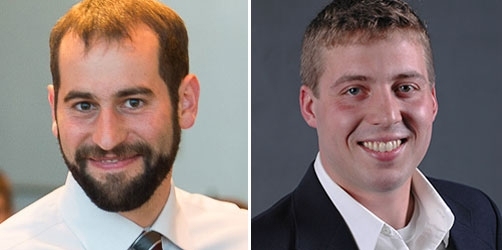
Graduate students William Boyd and Andrew Dykhuis of the Department of Nuclear Science and Engineering (NSE) have earned 2015 Innovations in Fuel Cycle Research Awards, which are sponsored by the U.S. Department of Energy's (DOE) Office of Fuel Cycle Technologies.
Boyd, a PhD student, has been awarded a first-place prize in the category of nuclear science and engineering. His award-winning research paper, “The OpenMOC Method of Characteristics Neutral Particle Transport Code,” was published in the Annals of Nuclear Energy last June.
Dykhuis, a PhD student and research assistant in NSE, has been awarded a second-place prize in the category of advanced fuels. His award-winning research paper, “HOGNOSE: A New Model for Corrosion in PWRs,” was presented at the American Nuclear Society Annual Meeting this June.
The Innovations in Fuel Cycle Research Awards program is designed to award graduate and undergraduate students for innovative fuel-cycle-relevant research publications; demonstrate DOE's commitment to higher education in fuel-cycle-relevant disciplines; and support communications among students and DOE representatives.
The program awarded 18 prizes in 2015 for student publications relevant to the nuclear fuel cycle. In addition to cash awards, winning students will have a variety of other academic opportunities.