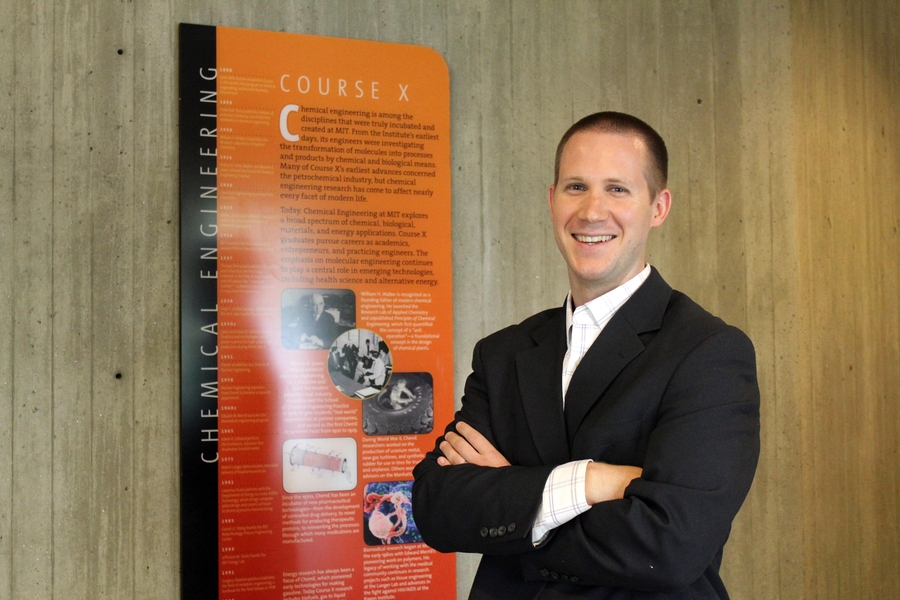
Assistant professor of chemical engineering William Tisdale has received a 2014 3M Non-Tenured Faculty Award, which recognizes outstanding new faculty who excel in research, experience, and academic leadership. Tisdale was recognized for his research on quantum dots — incredibly small crystals that exhibit quantum mechanical properties.
The award, administered by 3M’s Research and Development Community, is given in partnership with 3M's Corporate Giving Program. For more than 25 years, the award has been given to help young faculty achieve tenure while remaining in teaching positions and conducting research. Recipients are nominated by 3M researchers.
Research in the Tisdale Lab focuses on energy transport phenomena in nanostructured materials. Tisdale studies the mechanisms by which excitons, free charges, phonons (heat), and reactive chemical species are converted to more useful forms of energy. His work also focuses on how to leverage this understanding to guide materials design and process optimization. Tisdale is actively engaged in the synthesis of colloidal nanoparticles, the investigation of methods for assembling these nanoscale building blocks into functional materials, and the development of spectroscopic tools for interrogating their properties.
Tisdale received his PhD in chemical engineering at the University of Minnesota in 2010, and his bachelor’s degree in chemical engineering (magna cum laude) from the University of Delaware in 2005. Before joining the faculty at MIT, Tisdale was a postdoctoral associate in the group of Vladimir Bulovic in MIT’s Research Laboratory of Electronics.