Skip to content ↓

Why networking doesn't work

New study reveals the strength of the strongest ties in collaborative problem solving.

Press Contact:

Alexandra Kahn
Phone: 617-253-0365
MIT Media Lab
Close
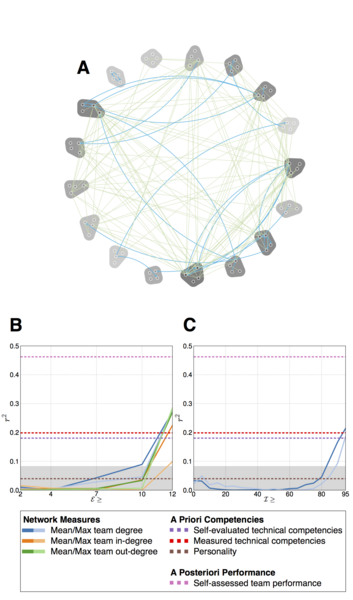
The network of teams' strongest expressive and instrumental ties. Only the strongest ties matter for performance, and those ties predict performance better than any other metrics (including technical abilities, familiarity with the topic, and personality).
Caption:
The network of teams' strongest expressive and instrumental ties. Only the strongest ties matter for performance, and those ties predict performance better than any other metrics (including technical abilities, familiarity with the topic, and personality).
Credits:
Image courtesy of the researchers

In a study published recently in Nature Scientific Reports, MIT Media Lab researchers showed that networking does not improve team performance. Their findings showed that only the participants' strongest ties had an actual effect on their performance — and the stronger the ties a team had, the better the team performed. None of the participants' weak instrumental (goal-oriented) or expressive (personal) networking ties significantly impacted the performance of their teams.

The research further showed that a team's strongest ties were the best predictor of its performance. A team's strongest ties indicated a performance better than the technical abilities of its members, what the members already knew on the topic, or their personality types.

When solving problems in a competitive environment, the study revealed, it does not matter how many people someone knows or networks with — what really matters are the strongest ties in the network. This has implications for the organization of teams of scientists, engineers, and a host of others tackling today's most complex problems.

The paper, "The Strength of the Strongest Ties in Collaborative Problem Solving," was published in the June 20 issue of Nature Scientific Reports and co-authored by graduate students Yves-Alexandre de Montjoye and Arkadiusz Stopczynski; postdoc Erez Shmueli; Alex Pentland, the Tobisha Professor of Media Arts and Sciences; and Sune Lehmann, a professor at the Technical University of Denmark.
Related Links

Related Topics

More MIT News

Globular blue and white orbs "examining" single-stranded RNA products and marking them with green checks or red x's

Why are some bacterial genes high in purines?

In certain species of bacteria, the answer lies in shielding RNA transcripts from a quality-control factor called Rho. Understanding the requirements for expressible sequences is critical for expression engineering of therapeutic agents.

Read full story

Rich Nielsen, Volha Charnysh, Kevin Dorst, and Emily Richmond Pollock seated at a table, talking

Building a scholarly community

The SHASS Faculty Fellows Program, administered by the MIT Human Insight Collaborative, is fostering new research projects and creating space for supportive and interdisciplinary discussion.

Read full story