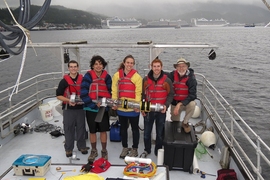
An MIT-Olin team took home the grand prize this October from the 2014 Maritime RobotX Challenge in Marina Bay, Singapore. The team was comprised of students from MIT’s Department of Mechanical Engineering and Computer Science and Artificial Intelligence Laboratory (CSAIL) as well as students from Olin College of Engineering.
The Maritime RobotX Challenge, which was funded by the Office of Naval Research (ONR), invited 15 student teams from five countries to build an unmanned surface vehicle that could best address real-world problems such as search-and-rescue missions, shipping security, environmental monitoring, fishery management, and marine science.
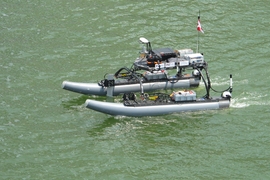
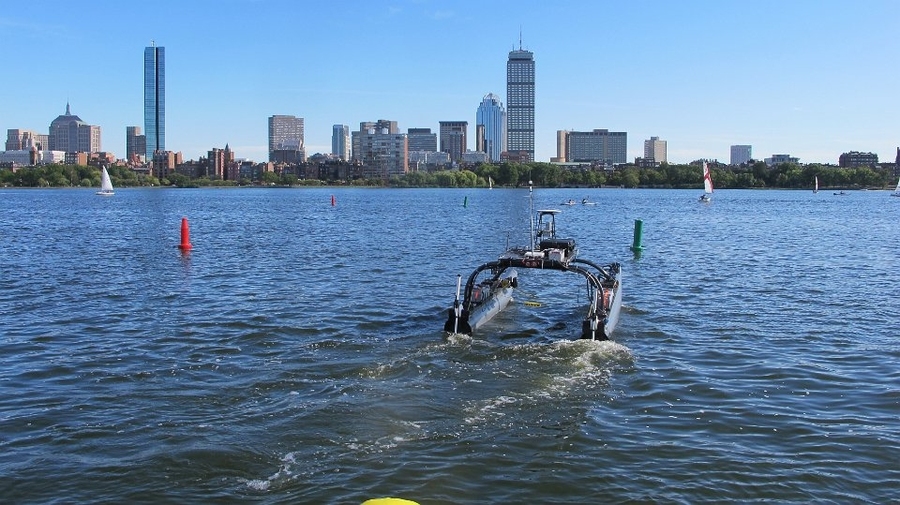
Each team received a skeletal 16-foot vehicle and was challenged to add propulsion, computing, sensor, navigation, and power systems.
The MIT-Olin team split the build into two phases: The initial construction was completed by Olin students, who then passed it off to MIT students for subsequent mechanical and software development.
MIT students equipped the vessel with the MIT Open Source software system called MOOS-IvP, a suite of modules taught in Professor Henrik Schmidt and Michael Benjamin’s class, 2.680 (Marine Autonomy, Sensing, and Communications), of which many team members were alumni. They also included a Velodyne HDL-32E LIDAR sensor, a Hemisphere GPS system, a top-mounted web camera, a four-element hydrophone array, and four separate computing systems to distribute the computational load of the autonomy and sensor processing systems. All four computers communicated with one another using the MOOS Open Source middleware, initially developed at MIT by Paul Newman.
But even with the team’s diligence and attention to detail, they weren’t prepared for the catastrophic mechanical failure the vessel experienced as the result of a manufacturer’s defect only four weeks before the final competition. Their vessel capsized in the Charles River, losing nearly all computing systems in the process.
“Amazingly, the students re-built the vehicle in just 10 days and went on to win the first place prize. The greatest asset of our team was their persistence and selflessness in helping each other out. Everyone on the team should be very proud,” says Benjamin, an advisor to the team.
The MIT-Olin team also won the Best Paper Award (along with a team from the Queensland University of Technology in Australia) and the Open Source Award for the technical help they gave to Singapore University of Technology and Design (SUTD) during the competition.
Learn more at the MIT-Olin team’s website.