Skip to content ↓

NSE’s Lulu Li wins best poster award at CASL workshop

Press Contact:

Ilavenil Subbiah
Phone: 617-680-0959
Nuclear Science and Engineering
Close
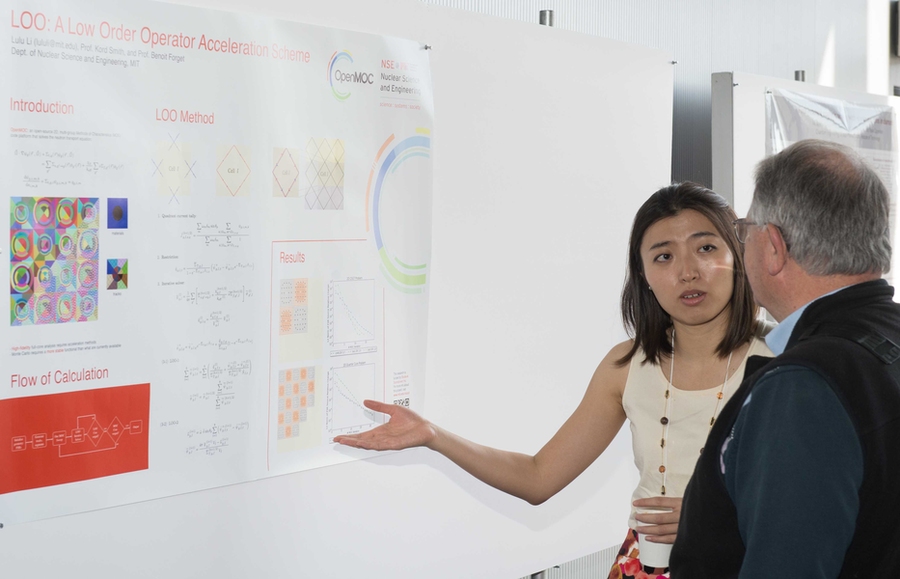
NSE graduate student Lulu Li's poster describes her work on computational physics methods for modeling and simulation of nuclear reactor cores.
Caption:
NSE graduate student Lulu Li's poster describes her work on computational physics methods for modeling and simulation of nuclear reactor cores.
Credits:
Photo: Justin Knight

Lulu Li, a graduate student in nuclear science and engineering, has won the award for the best poster presented at the 2014 CASL Annual Education Workshop. Li’s poster described a new physics-based multigrid acceleration method implemented and tested in the OpenMOC framework.

At MIT, Li works with professors Kord Smith and Benoit Forget in the Computational Reactor Physics Group (CRPG). CRPG focuses on computational physics methods for modeling and simulation of nuclear reactor cores, including reactor physics analysis methods, core loading design and optimization, and transient safety analysis.

Li is one of the co-developers of the open-source Method of Characteristics neutron transport code called OpenMOC. Her research on nonlinear acceleration techniques is contributing to the development of  the numerical algorithms and acceleration schemes that are necessary for efficient simulation of reactor problems.

CASL is the U.S. Department of Energy’s Consortium for Advanced Simulation of Light Water Reactors. It connects fundamental research and technology development through an integrated partnership of government, academia, and industry that extends across the nuclear energy enterprise.

Related Links

Related Topics

Related Articles

More MIT News

Globular blue and white orbs "examining" single-stranded RNA products and marking them with green checks or red x's

Why are some bacterial genes high in purines?

In certain species of bacteria, the answer lies in shielding RNA transcripts from a quality-control factor called Rho. Understanding the requirements for expressible sequences is critical for expression engineering of therapeutic agents.

Read full story

Rich Nielsen, Volha Charnysh, Kevin Dorst, and Emily Richmond Pollock seated at a table, talking

Building a scholarly community

The SHASS Faculty Fellows Program, administered by the MIT Human Insight Collaborative, is fostering new research projects and creating space for supportive and interdisciplinary discussion.

Read full story