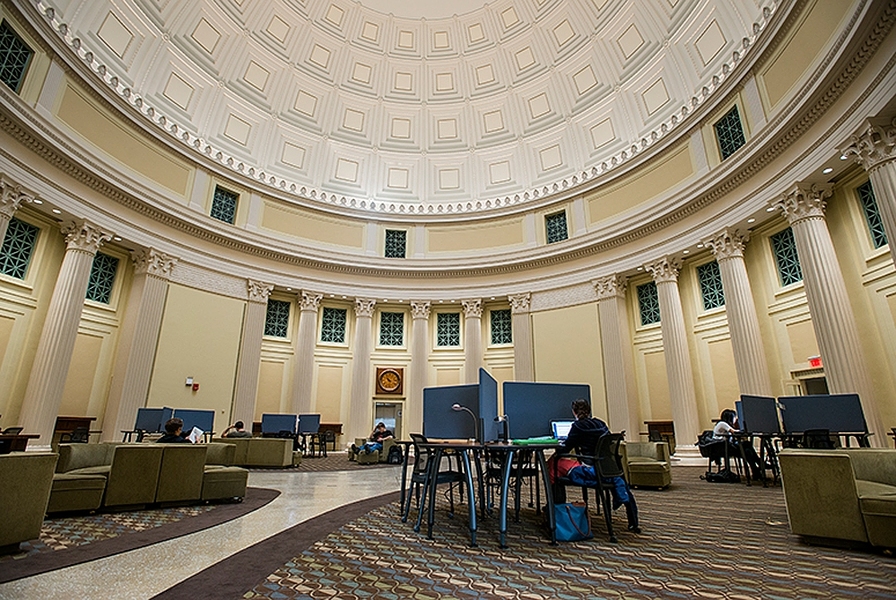
After an extensive renovation project, the Barker Library reading room has reopened to reveal the grandeur of the restored oculus atop the Great Dome, and the beauty of the rotunda’s original architecture. Now it can be enjoyed by the MIT community 24 hours a day, seven days a week.
First opened in 1916 as the Institute’s original library reading room, the space has always served as a reading room but has undergone many transformations over the years. After months of meticulous restoration, the oculus has been reopened to allow natural light to once again fill the reading room. Additional LED lighting around the perimeter of the rotunda highlights decorative acanthus leaves and other details once unnoticed.
During the renovation the reading room was outfitted as a 24-hour study space, with a new entryway added for secure access. Students can enjoy the beauty of the restored room as well as other comforts — acoustic panels and a new sound-mitigation system help soften echoes and ambient noise, and comfortable chairs, large tables, and individual study carrels have also returned to the reading room. All of these make it a perfect space for quiet study any time of the day or night.
First opened in 1916 as the Institute’s original library reading room, the space has always served as a reading room but has undergone many transformations over the years. After months of meticulous restoration, the oculus has been reopened to allow natural light to once again fill the reading room. Additional LED lighting around the perimeter of the rotunda highlights decorative acanthus leaves and other details once unnoticed.
During the renovation the reading room was outfitted as a 24-hour study space, with a new entryway added for secure access. Students can enjoy the beauty of the restored room as well as other comforts — acoustic panels and a new sound-mitigation system help soften echoes and ambient noise, and comfortable chairs, large tables, and individual study carrels have also returned to the reading room. All of these make it a perfect space for quiet study any time of the day or night.