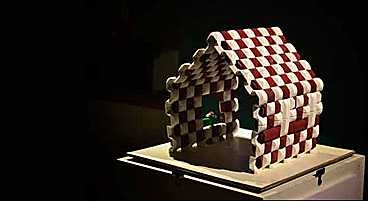
Five graduate students from the School of Architecture + Planning — candidates for degrees in media studies, in architecture, and in art, culture and technology — took all the top honors in this year’s annual visual arts awards.
The Harold and Arlene Schnitzer Prize in the Visual Arts was established in 1996 through an endowment from Harold and Arlene Schnitzer of Portland, Ore., to recognize excellence in a body of student artistic work; in recent years, SA+P students have regularly dominated the awards.
This year’s first place prize of $5,000 went to Jie Qi, a graduate student in the High-Low Tech group at the Media Lab. Qi uses traditional art-making methods with electronics to produce works that are both playful and profound. "The goal of my research and my artwork," she says, "is really to share and empower people to use technology … to express themselves so that they too feel like they have these magical crayons to turn …what only exists in their dreams into reality… This idea of telling stories, of expressing yourself in new ways is the point that I’m hoping to share."
Read about the other winners and see their work
The Harold and Arlene Schnitzer Prize in the Visual Arts was established in 1996 through an endowment from Harold and Arlene Schnitzer of Portland, Ore., to recognize excellence in a body of student artistic work; in recent years, SA+P students have regularly dominated the awards.
This year’s first place prize of $5,000 went to Jie Qi, a graduate student in the High-Low Tech group at the Media Lab. Qi uses traditional art-making methods with electronics to produce works that are both playful and profound. "The goal of my research and my artwork," she says, "is really to share and empower people to use technology … to express themselves so that they too feel like they have these magical crayons to turn …what only exists in their dreams into reality… This idea of telling stories, of expressing yourself in new ways is the point that I’m hoping to share."
Read about the other winners and see their work