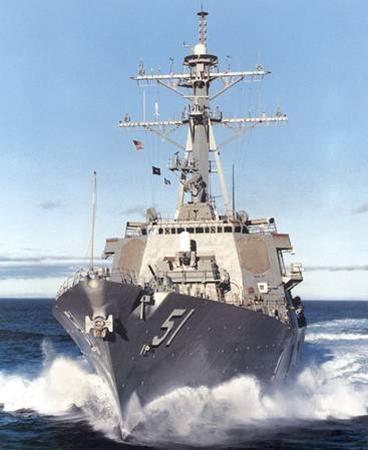
The U.S. Navy’s Arleigh Burke (DDG-51) class of destroyers consists of 62 active vessels that collectively carry 20,000 personnel and burn 4.4 million barrels of fuel each year. Since the first hull was commissioned in 1991, there have been two major design revisions (“flights”), and Flight III is currently in the works. Such a revision, as well as regular operations and maintenance, relies heavily on the standard operating profile of speeds and powering configurations — in short, how each ship spends its working life.
Now, Course 2N (Ocean Engineering) students Travis Anderson, Katie Gerhard and Bart Sievenpiper, in coordination with the Navy Electric Ship Office, have turned that long-standing profile on its head. They have dissected the deck logs — often hand-written — of 16 active ships, analyzing more than 28,000 hours of operations over the past few years and updating crucial collective knowledge about their operations with more in-depth data than previously existed.
What they have discovered is markedly different from what was assumed when the ships were first designed. The original profile lumped all operations at eight knots or less into a single category, while the new profile analyzes them at one-knot increments. As a result of this more precise grouping, the ships are now known to spend 47 percent of their operational time — a percentage previously thought to be 28 percent — at low speeds. This new information allows designers and commanding officers to make configuration changes and decisions that will significantly increase fuel efficiency and decrease long-term costs. The updated profile gives more detail at higher speeds as well, showing, for example, that a typical vessel spends less than 0.5 percent of its operating hours above 28 knots.
In his Naval Engineer’s thesis (advised by Professor Franz Hover), Travis Anderson SM ‘13 further explored the statistical properties of the new profile. This work not only showed remarkable variation of operations across the individual ships but also that much of it can be attributed to a single leading “mode” of randomness, which he captured in a principal components analysis (PCA).
The work has set a precedent in the Navy as the first systematic investigation of operating conditions drawn from a large number of active vessels. The group's DDG-51 findings proved so valuable that the profile has already been entered into the official Design Data Sheet for DDG-51 by the Naval Sea Systems Command (awaiting final approval at this writing). The authors were also asked to apply the same process to the LSD-41 (Whidbey Island) class of dock-landing ships and the LPD-17 (San Antonio) class.
Now, Course 2N (Ocean Engineering) students Travis Anderson, Katie Gerhard and Bart Sievenpiper, in coordination with the Navy Electric Ship Office, have turned that long-standing profile on its head. They have dissected the deck logs — often hand-written — of 16 active ships, analyzing more than 28,000 hours of operations over the past few years and updating crucial collective knowledge about their operations with more in-depth data than previously existed.
What they have discovered is markedly different from what was assumed when the ships were first designed. The original profile lumped all operations at eight knots or less into a single category, while the new profile analyzes them at one-knot increments. As a result of this more precise grouping, the ships are now known to spend 47 percent of their operational time — a percentage previously thought to be 28 percent — at low speeds. This new information allows designers and commanding officers to make configuration changes and decisions that will significantly increase fuel efficiency and decrease long-term costs. The updated profile gives more detail at higher speeds as well, showing, for example, that a typical vessel spends less than 0.5 percent of its operating hours above 28 knots.
In his Naval Engineer’s thesis (advised by Professor Franz Hover), Travis Anderson SM ‘13 further explored the statistical properties of the new profile. This work not only showed remarkable variation of operations across the individual ships but also that much of it can be attributed to a single leading “mode” of randomness, which he captured in a principal components analysis (PCA).
The work has set a precedent in the Navy as the first systematic investigation of operating conditions drawn from a large number of active vessels. The group's DDG-51 findings proved so valuable that the profile has already been entered into the official Design Data Sheet for DDG-51 by the Naval Sea Systems Command (awaiting final approval at this writing). The authors were also asked to apply the same process to the LSD-41 (Whidbey Island) class of dock-landing ships and the LPD-17 (San Antonio) class.