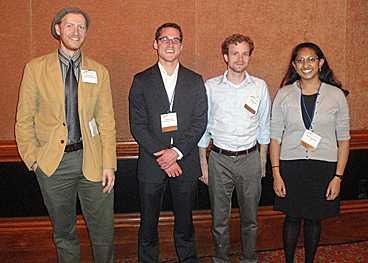
Four MIT students won first place in a competition by the U.S. Association of Energy Economics (USAEE) aimed at tackling today’s energy challenges and preparing solutions for policymakers and industry. The students, Ashwini Bharatkumar, Michael Craig, Daniel Cross-Call and Michael Davidson, competed against teams from other North American universities to develop a business model for a fictitious utility company in California facing uncertain electricity growth from a rise in electric vehicle charging.
“Overall, the case competition was a great opportunity to consider solutions to the very challenges that electric utilities are facing today,” Bharatkumar says.
With the goal of minimizing distribution system upgrade costs, the MIT team tested how well several business models or technology alternatives could address the utility company’s challenge. These included: implementing a real-time pricing and demand response program, using battery storage, using controlled charging or some combination of the three.
The MIT students found that, instead of simply expanding the transmission and distribution network to accommodate the increased demand, the better course of action would be to install advanced metering infrastructure and implement controlled charging to shift the electric vehicle load to off-peak hours. They also recommended modifying the rate structure to include capacity — not just energy — costs. For example, grid users choosing to charge their vehicles during peak hours would incur an additional fee.
The team presented its recommendations at the annual USAEE and International Association for Energy Economics North American Conference in Anchorage, Alaska on July 29-31.
“Overall, the case competition was a great opportunity to consider solutions to the very challenges that electric utilities are facing today,” Bharatkumar says.
With the goal of minimizing distribution system upgrade costs, the MIT team tested how well several business models or technology alternatives could address the utility company’s challenge. These included: implementing a real-time pricing and demand response program, using battery storage, using controlled charging or some combination of the three.
The MIT students found that, instead of simply expanding the transmission and distribution network to accommodate the increased demand, the better course of action would be to install advanced metering infrastructure and implement controlled charging to shift the electric vehicle load to off-peak hours. They also recommended modifying the rate structure to include capacity — not just energy — costs. For example, grid users choosing to charge their vehicles during peak hours would incur an additional fee.
The team presented its recommendations at the annual USAEE and International Association for Energy Economics North American Conference in Anchorage, Alaska on July 29-31.