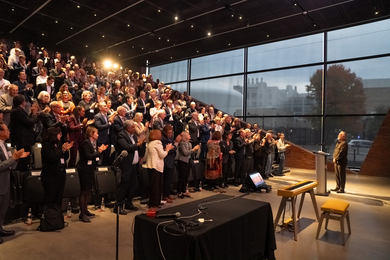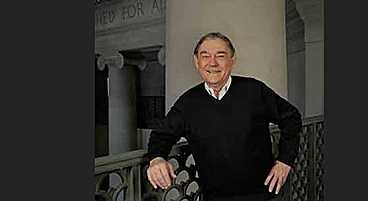
In May, a group of 40-50 alumni from the School of Architecture + Planning assembled at MIT from as far away as Europe and Asia to attend the last session of Julian Beinart’s class on the Theory of City Form, a class he’d taught since 1977.
Initiated by alumnus Isaac Manning (SMArchS’ 90) — president of Trinity Works, a real estate development firm based in Fort Worth — the event was an opportunity for alumni who had taken the course to honor the importance of the class, and of Beinart, to their careers.
A seminal course at the intersection of architecture, planning, real estate, economics, history and theory, Theory of City Form examined examples of urban design over time, concentrating on the origins of the modern city and theories about its emerging contours, including the transformation of the 19th-century city and its organization. It also analyzed current issues of city form in relation to city-making, social structure and physical design.
The class has been taken by hundreds of students over the years since Kevin Lynch introduced the subject in the mid-fifties — a nearly 60-year legacy that would be hard to overstate. "People have gone out and changed the world because of that course," says Manning. "It has touched a tremendous number of lives."
Read the full article
Initiated by alumnus Isaac Manning (SMArchS’ 90) — president of Trinity Works, a real estate development firm based in Fort Worth — the event was an opportunity for alumni who had taken the course to honor the importance of the class, and of Beinart, to their careers.
A seminal course at the intersection of architecture, planning, real estate, economics, history and theory, Theory of City Form examined examples of urban design over time, concentrating on the origins of the modern city and theories about its emerging contours, including the transformation of the 19th-century city and its organization. It also analyzed current issues of city form in relation to city-making, social structure and physical design.
The class has been taken by hundreds of students over the years since Kevin Lynch introduced the subject in the mid-fifties — a nearly 60-year legacy that would be hard to overstate. "People have gone out and changed the world because of that course," says Manning. "It has touched a tremendous number of lives."
Read the full article