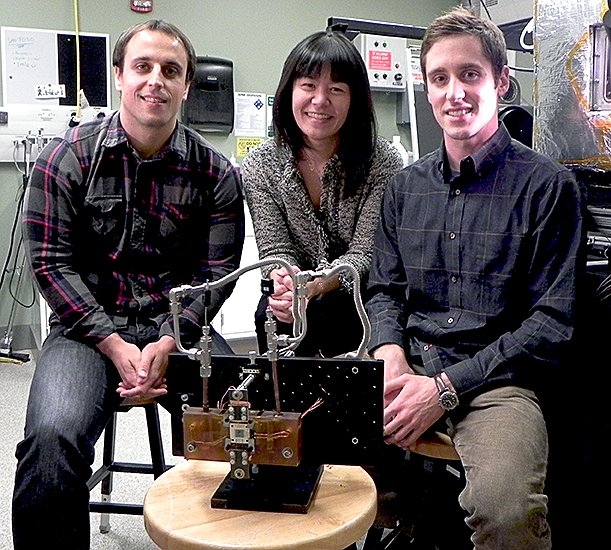
Efficient heat and mass transfer for devices from a thermal battery to air condition electric vehicles to cooling for steam power plants is the focus of Evelyn Wang, Associate Professor of Mechanical Engineering, at MIT, and principal investigator of the Device Research Laboratory. “In general, our lab works a lot on using micro and nanostructures for various thermal-fluid applications,” Wang says. Among key recent projects in Wang’s group are:
- Former graduate student and postdoctoral associate Nenad Miljkovic pioneered highly scalable nanostructured coatings for copper tubing that shed water efficiently, boost heat flux by 25 percent and raise the condensation heat transfer coefficient by 30 percent. The work has applications for power plants, thermal desalination, dehumidification, and other industrial uses. Wang is principal investigator in a multi-site, ARPA-E funded project to develop a thermal battery for heating and cooling in electric vehicles. Postdoctoral associate Shankar Narayanan is leading work on an adsorption bed for the battery and graduate student Ian McKay is exploring how to integrate Miljkovic’s discoveries regarding superhydrophobic and superhydrophilic surfaces into the evaporator-condenser design.
- Graduate student Andrej Lenert and colleagues are developing solar thermophotovoltaic systems based on photonic crystal absorbers and emitters that promise to deliver 10 percent efficiency. See related article.
- Miljkovic and colleagues demonstrated enhanced jumping behavior of water droplets on a copper pipe which he made superhydrophobic by growing a thin layer of silanized copper oxide as reported in a November 2012 Nano Letters paper, “Jumping-Droplet-Enhanced Condensation on Scalable Superhydrophobic Nanostructured Surfaces.”